
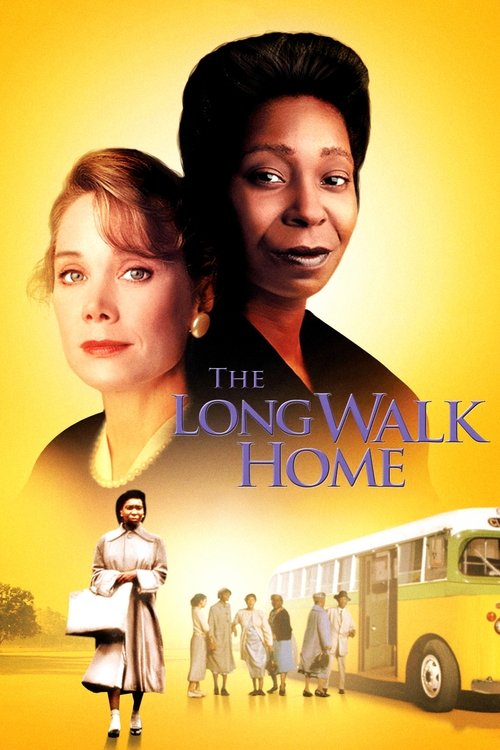
The Long Walk Home
1990 · 97 min · Director: Richard Pearce
Show plot summary (may contain spoilers)
Dramatizes the events in 1955-1956 in Montgomery, Alabama, when blacks boycotted public transport because they were forced to sit at the back. Odessa works as a maid for the Thompsons, and as well as she is treated, she feels it is her duty to walk to work, even if it means she is exhausted, and gets to work late.
Emotional fingerprint
The Long Walk Home (1990) — Movie. Top emotional signals: Empathy 30%, Inspiration 25%, Sadness 20%. Source: AI estimate. Shares describe emotional signal, not percentages of people. Your experience may differ. How we measure
- Empathy30%
- Inspiration25%
- Sadness20%
- Anger15%
- Hope10%
AI estimate · no viewer votes yet
How we measure
AI estimate
Share of emotional signal, not the percentage of people or a probability of enjoyment.
Each viewer contributes one response, split equally across their selected emotions. When available, an automated estimate supplies a prior that is blended with those responses. Counts include distinct viewers, not automated estimates or archived anonymous votes. Fewer than 3 viewers is an early estimate; more responses do not guarantee certainty.
Why it feels this way
The strongest emotional signals are Empathy, Inspiration, Sadness. Genres: Drama, History. AI estimate.
Is it worth watching?
Consider this title if you are looking for Empathy, Inspiration and Sadness. Its IMDb rating of 7.3/10 suggests a generally positive audience reception. For these leading emotions, its Feel Score is 71/100.
How did it make you feel?
Votes are saved to the fingerprint once you’re signed in.
Pick up to three · 0/3
Emotional journey
- Empathy
- Hope
- Tension
Not enough subtitle evidence
No dominant emotion
Dominant emotion: Hope
Dominant emotion: Anger
Dominant emotion: Empathy
Dominant emotion: Tension
Dominant emotion
| % | Approximate minute | Dominant emotion | Overall intensity | Empathy | Hope | Tension |
|---|---|---|---|---|---|---|
| 2.5 % | ≈ 2′ | Hope | 42 % | 35 % | 17 % | 17 % |
| 7.5 % | ≈ 7′ | Anger | 53 % | 45 % | 20 % | 31 % |
| 12.5 % | ≈ 12′ | Hope | 53 % | 48 % | 29 % | 29 % |
| 17.5 % | ≈ 17′ | Empathy | 52 % | 49 % | 39 % | 21 % |
| 22.5 % | ≈ 22′ | Hope | 56 % | 50 % | 41 % | 25 % |
| 27.5 % | ≈ 27′ | Empathy | 49 % | 39 % | 24 % | 28 % |
| 32.5 % | ≈ 32′ | Anger | 50 % | 38 % | 19 % | 31 % |
| 37.5 % | ≈ 36′ | Empathy | 57 % | 46 % | 29 % | 36 % |
| 42.5 % | ≈ 41′ | Tension | 64 % | 53 % | 21 % | 50 % |
| 47.5 % | ≈ 46′ | Anger | 75 % | 66 % | 20 % | 65 % |
| 52.5 % | ≈ 51′ | Empathy | 73 % | 63 % | 29 % | 59 % |
| 57.5 % | ≈ 56′ | Anger | 68 % | 50 % | 34 % | 50 % |
| 62.5 % | ≈ 61′ | Hope | 73 % | 55 % | 36 % | 53 % |
| 67.5 % | ≈ 65′ | Anger | 74 % | 63 % | 28 % | 53 % |
| 72.5 % | ≈ 70′ | Empathy | 71 % | 68 % | 32 % | 46 % |
| 77.5 % | ≈ 75′ | Hope | 70 % | 68 % | 55 % | 44 % |
| 82.5 % | ≈ 80′ | Hope | 74 % | 65 % | 55 % | 54 % |
| 87.5 % | ≈ 85′ | Tension | 84 % | 71 % | 45 % | 75 % |
| 92.5 % | ≈ 90′ | Empathy | 90 % | 71 % | 61 % | 69 % |
| 97.5 % | ≈ 95′ | Hope | 88 % | 57 % | 80 % | 37 % |
Man in a hole
Rags to riches: The emotional tone rises from negative to positive.
Riches to rags: The emotional tone falls from positive to negative.
Man in a hole: The tone falls, then recovers.
Icarus: The tone rises, then falls.
Cinderella: The tone rises, falls, then rises again.
Oedipus: The tone falls, rises, then falls again.
AI reading of the film’s English subtitles (dialogue and sound cues) — not viewer votes. How we measure ↗
Kadri — your film companion
AIAsk anything about The Long Walk Home. From the film’s own dialogue and FeelDB data, at your spoiler level.
Afterward Reveal viewer responses · may contain spoilers
Viewer responses about feelings after the title ended, separate from feelings while watching. No AI estimates.
0 responses so far
Feeling details appear after at least 3 viewers respond, to protect privacy.
Cast






Mary Catherine
Theodore Cotter
Sara Thompson
Claudia


Anne (Girl at Oak Park)
Policeman at Oak Park
Roger
Lucille
Mr. Cooper
Details
- Directed by
- Richard Pearce
- Written by
- John Cork
- Type
- Movies
- Released
- 1990
- Runtime
- 97 min
- Country
- United States
- Ratings
- Feels mostly
- Empathy
- Data updated
Where to watch
Subscription


Free
-
 The CW
Opens in a new tab
-
 Fawesome
Opens in a new tab
-
 The Roku Channel
Opens in a new tab
-
 Fandango at Home Free
Opens in a new tab
-
 Pluto TV
Opens in a new tab
-
 YouTube Free
Opens in a new tab
-
 Plex
Opens in a new tab
-
 Plex Channel
Opens in a new tab
-
 Amazon Prime Video Free with Ads
Opens in a new tab
-
 Xumo Play
Opens in a new tab
-
 Tubi TV
Opens in a new tab
-
 Amazon MX Player
Opens in a new tab

Feels similar
More like this →Emotion overlap shows mood similarity, not a prediction of enjoyment.