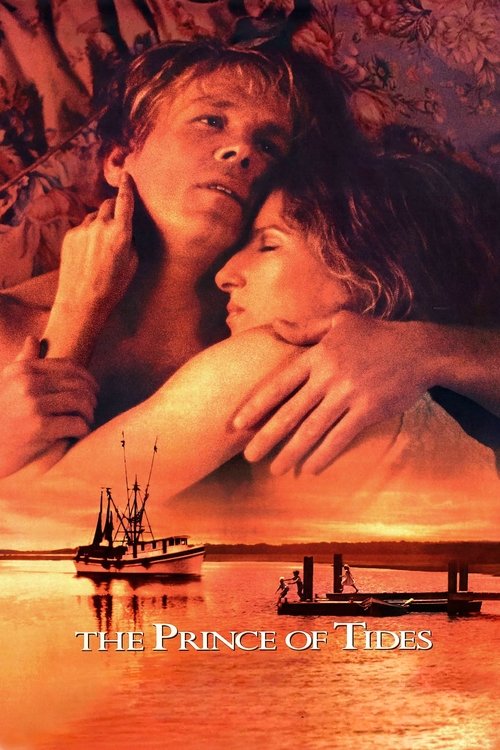
The Prince of Tides
1991 · 132 min · Director: Barbra Streisand
Show plot summary (may contain spoilers)
The Wingo family is from South Carolina, they growing up in a house on a tidal plain. The oldest offspring, Lucas, largely acted as the protector for his younger twins siblings, Tom and Savannah, in light of their dysfunctional growing up, with their shrimper father, Henry, distant and abusive if/when he did pay them any attention, and their mother, Lila, while not doting on them most concerned about appearances and striving for social standing. Now in middle age, Savannah is a New York based poet, Tom, still living on the South Carolina coast outside of Charleston with his wife Sally and their own three doting daughters, taking a break from his high school teaching/football coaching job, while Lucas has long since died while still standing up for himself and his beliefs. Lila, divorced and now remarried with that wealth and social standing she so long desired, receives news that Savannah is in the hospital following her most recent suicide attempt. Not wanting to face the blame directly as she suspects, she assigns Tom to go to New York to speak to Savannah's therapist, Susan Loewenstein, to provide any information of a family history nature that could help in Savannah's recovery. Tom agrees despite hating New York, and it being not a good time since he and Sally are experiencing marital problems, they both just knowing that things between them are not working, and not having been intimate in months. As Tom and Loewenstein (as he calls her) begin their sessions, Tom is slow to divulge the Wingo family problems to her. But he learns that she too is having her own family problems, with her concert violinist husband Herbert Woodruff being self absorbed and condescending, with their young adult son, Bernard, hating both largely because of they predestining his life also as a concert violinist. Tom and Loewenstein's sessions blossom into a friendship and romance, where their talks, in addition to helping Savannah, may help them both in dealing with their own life problems, Tom's which have been long buried figuratively and literally.
Emotional fingerprint
The Prince of Tides (1991) — Movie. Top emotional signals: Empathy 30%, Sadness 25%, Love 20%. Source: AI estimate. Shares describe emotional signal, not percentages of people. Your experience may differ. How we measure
- Empathy30%
- Sadness25%
- Love20%
- Melancholy15%
- Anger10%
AI estimate · no viewer votes yet
How we measure
AI estimate
Share of emotional signal, not the percentage of people or a probability of enjoyment.
Each viewer contributes one response, split equally across their selected emotions. When available, an automated estimate supplies a prior that is blended with those responses. Counts include distinct viewers, not automated estimates or archived anonymous votes. Fewer than 3 viewers is an early estimate; more responses do not guarantee certainty.
Why it feels this way
The strongest emotional signals are Empathy, Sadness, Love. Genres: Drama, Romance. AI estimate.
Is it worth watching?
Consider this title if you are looking for Empathy, Sadness and Love. Its IMDb rating of 6.8/10 suggests a generally positive audience reception. For these leading emotions, its Feel Score is 70/100.
How did it make you feel?
Votes are saved to the fingerprint once you’re signed in.
Pick up to three · 0/3
Emotional journey
- Empathy
- Sadness
- Love
Not enough subtitle evidence
No dominant emotion
Dominant emotion: Love
Dominant emotion: Sadness
Dominant emotion: Tension
Dominant emotion: Humor
Dominant emotion: Empathy
Dominant emotion
| % | Approximate minute | Dominant emotion | Overall intensity | Empathy | Sadness | Love |
|---|---|---|---|---|---|---|
| 2.5 % | ≈ 3′ | Love | 40 % | 32 % | 27 % | 23 % |
| 7.5 % | ≈ 10′ | Sadness | 44 % | 35 % | 30 % | 14 % |
| 12.5 % | ≈ 17′ | Tension | 49 % | 36 % | 30 % | 9 % |
| 17.5 % | ≈ 23′ | Tension | 46 % | 34 % | 25 % | 14 % |
| 22.5 % | ≈ 30′ | Humor | 48 % | 40 % | 34 % | 19 % |
| 27.5 % | ≈ 36′ | Sadness | 54 % | 46 % | 45 % | 23 % |
| 32.5 % | ≈ 43′ | Humor | 49 % | 36 % | 31 % | 25 % |
| 37.5 % | ≈ 50′ | Humor | 43 % | 28 % | 15 % | 25 % |
| 42.5 % | ≈ 56′ | Humor | 45 % | 29 % | 16 % | 30 % |
| 47.5 % | ≈ 63′ | Humor | 49 % | 34 % | 28 % | 38 % |
| 52.5 % | ≈ 69′ | Sadness | 49 % | 38 % | 34 % | 41 % |
| 57.5 % | ≈ 76′ | Love | 51 % | 39 % | 31 % | 38 % |
| 62.5 % | ≈ 83′ | Tension | 68 % | 54 % | 45 % | 23 % |
| 67.5 % | ≈ 89′ | Sadness | 83 % | 74 % | 66 % | 14 % |
| 72.5 % | ≈ 96′ | Empathy | 73 % | 69 % | 56 % | 23 % |
| 77.5 % | ≈ 102′ | Humor | 55 % | 49 % | 30 % | 34 % |
| 82.5 % | ≈ 109′ | Humor | 54 % | 39 % | 21 % | 44 % |
| 87.5 % | ≈ 116′ | Love | 64 % | 45 % | 35 % | 59 % |
| 92.5 % | ≈ 122′ | Love | 71 % | 56 % | 55 % | 70 % |
| 97.5 % | ≈ 129′ | Love | 70 % | 57 % | 58 % | 72 % |
Cinderella
Rags to riches: The emotional tone rises from negative to positive.
Riches to rags: The emotional tone falls from positive to negative.
Man in a hole: The tone falls, then recovers.
Icarus: The tone rises, then falls.
Cinderella: The tone rises, falls, then rises again.
Oedipus: The tone falls, rises, then falls again.
AI reading of the film’s English subtitles (dialogue and sound cues) — not viewer votes. How we measure ↗
Afterward Reveal viewer responses · may contain spoilers
Viewer responses about feelings after the title ended, separate from feelings while watching. No AI estimates.
0 responses so far
Feeling details appear after at least 3 viewers respond, to protect privacy.
Cast







Bernard Woodruff
Lucy Wingo
Jennifer Wingo
Chandler Wingo
Tom Wingo (age 6)
Tom Wingo (age 10)
Tom Wingo (age 13)
Savannah Wingo (age 6)
Savannah Wingo (age 10)
Savannah Wingo (age 13)
Luke Wingo (age 9)
Luke Wingo (age 13)
Details
- Directed by
- Barbra Streisand
- Written by
- Becky Johnston, Pat Conroy
- Type
- Movies
- Released
- 1991
- Runtime
- 132 min
- Country
- United States
- Ratings
- Feels mostly
- Empathy
- Data updated
Where to watch
Rent


Feels similar
More like this →Emotion overlap shows mood similarity, not a prediction of enjoyment.