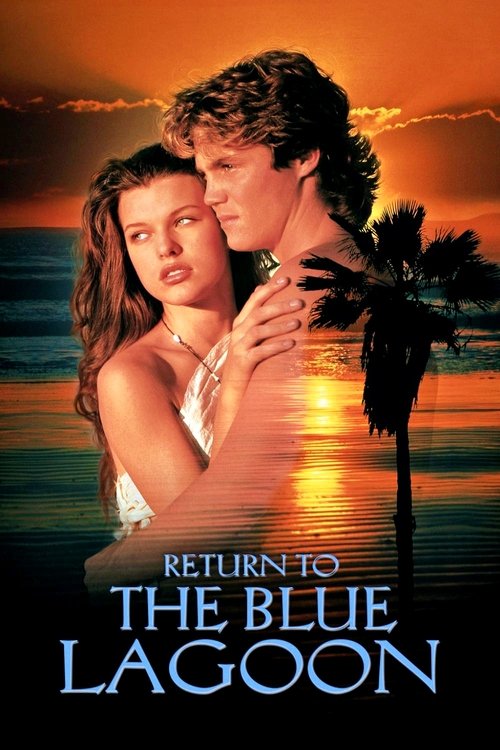
Return to the Blue Lagoon
1991 · 98 min · Director: William A. Graham
Show plot summary (may contain spoilers)
While the general theme of this film resembles "The Blue Lagoon" (the film for which this is a sequel), the basic plot is quite different. We open the film with a ship finding the craft with our original characters in it, Richard and Emmeline dead and Paddy alive. Established in the first film, the only word Paddy ever says is "Richard", so the crew assumes Richard is the infant's name. Taken in by Sarah, a widow with an infant baby girl Lilli, Richard (Paddy) is cared for in a return to civilization. Struck by cholera, the crew of the ship start to die and the captain sets Sarah, Richard, Lilli and a healthy crew member on a lifeboat in an attempt to preserve their lives. With water and food running short, the crew member escorting Sarah and the children becomes dangerous, so Sarah takes the only course of action she feels suitable to preserve the children: she strikes him and throws him overboard. Taking control of the small craft, she eventually guides them back to the island of the first film. The infant Richard, recognizing where he is, finds his home and is very upset not to find his parents. Fixing up the hut and settling in the children, Sarah begins their life on the island, slowly teaching the children survival tools, as well as schooling them as though they were in school, and teaching them slowly about the facts of life, including Lilli's eventual growth to womanhood. When Sarah dies from pneumonia, she leaves the children far more prepared than Richard and Emmeline in the first film. Years later as the children grow into adulthood, the film skims the same themes as the first of their developing relationship, and introduces the characters to civilization when a ship, low on fresh water, stops on their island and offers to take them home. After a confrontation with one of the crew and the captain's daughter, Lilli finds herself pregnant and they decide to stay, as they feel the civilization the visitors have to offer will not compare to the life they lead on the island.
Emotional fingerprint
Return to the Blue Lagoon (1991) — Movie. Top emotional signals: Awe 30%, Love 25%, Sadness 20%. Source: AI estimate. Shares describe emotional signal, not percentages of people. Your experience may differ. How we measure
AI estimate · no viewer votes yet
How we measure
AI estimate
Share of emotional signal, not the percentage of people or a probability of enjoyment.
Each viewer contributes one response, split equally across their selected emotions. When available, an automated estimate supplies a prior that is blended with those responses. Counts include distinct viewers, not automated estimates or archived anonymous votes. Fewer than 3 viewers is an early estimate; more responses do not guarantee certainty.
Why it feels this way
The strongest emotional signals are Awe, Love, Sadness. Genres: Drama, Romance, Adventure. AI estimate.
Is it worth watching?
Consider this title if you are looking for Awe, Love and Sadness. Its IMDb rating of 5.2/10 suggests a mixed audience reception; consider how well the emotional profile suits you. For these leading emotions, its Feel Score is 56/100.
How did it make you feel?
Votes are saved to the fingerprint once you’re signed in.
Pick up to three · 0/3
Emotional journey
- Love
- Tension
- Sadness
Not enough subtitle evidence
No dominant emotion
Dominant emotion: Sadness
Dominant emotion: Tension
Dominant emotion: Love
Dominant emotion: Humor
Dominant emotion: Curiosity
Dominant emotion
| % | Approximate minute | Dominant emotion | Overall intensity | Love | Tension | Sadness |
|---|---|---|---|---|---|---|
| 2.5 % | ≈ 2′ | Sadness | 68 % | 15 % | 60 % | 53 % |
| 7.5 % | ≈ 7′ | Tension | 76 % | 15 % | 71 % | 49 % |
| 12.5 % | ≈ 12′ | Tension | 76 % | 19 % | 66 % | 34 % |
| 17.5 % | ≈ 17′ | Love | 64 % | 34 % | 39 % | 26 % |
| 22.5 % | ≈ 22′ | Love | 56 % | 43 % | 31 % | 30 % |
| 27.5 % | ≈ 27′ | Humor | 53 % | 31 % | 31 % | 16 % |
| 32.5 % | ≈ 32′ | Humor | 55 % | 21 % | 31 % | 3 % |
| 37.5 % | ≈ 37′ | Tension | 68 % | 30 % | 43 % | 24 % |
| 42.5 % | ≈ 42′ | Sadness | 71 % | 46 % | 33 % | 49 % |
| 47.5 % | ≈ 47′ | Love | 60 % | 44 % | 21 % | 39 % |
| 52.5 % | ≈ 51′ | Tension | 53 % | 31 % | 28 % | 21 % |
| 57.5 % | ≈ 56′ | Humor | 55 % | 25 % | 34 % | 21 % |
| 62.5 % | ≈ 61′ | Tension | 65 % | 36 % | 42 % | 28 % |
| 67.5 % | ≈ 66′ | Love | 73 % | 48 % | 42 % | 19 % |
| 72.5 % | ≈ 71′ | Curiosity | 66 % | 29 % | 34 % | 5 % |
| 77.5 % | ≈ 76′ | Curiosity | 56 % | 16 % | 26 % | 6 % |
| 82.5 % | ≈ 81′ | Humor | 55 % | 23 % | 32 % | 18 % |
| 87.5 % | ≈ 86′ | Tension | 68 % | 33 % | 59 % | 28 % |
| 92.5 % | ≈ 91′ | Tension | 81 % | 55 % | 63 % | 25 % |
| 97.5 % | ≈ 96′ | Love | 83 % | 75 % | 37 % | 18 % |
Rags to riches
Rags to riches: The emotional tone rises from negative to positive.
Riches to rags: The emotional tone falls from positive to negative.
Man in a hole: The tone falls, then recovers.
Icarus: The tone rises, then falls.
Cinderella: The tone rises, falls, then rises again.
Oedipus: The tone falls, rises, then falls again.
AI reading of the film’s English subtitles (dialogue and sound cues) — not viewer votes. How we measure ↗
Afterward Reveal viewer responses · may contain spoilers
Viewer responses about feelings after the title ended, separate from feelings while watching. No AI estimates.
0 responses so far
Feeling details appear after at least 3 viewers respond, to protect privacy.
Cast

Young Lilli
Capt. Jacob Hilliard
Infant Lilli
Infant Richard
Sylvia Hilliard
Quinlan
Giddens
Penfield
First Mate
Details
- Directed by
- William A. Graham
- Written by
- Henry De Vere Stacpoole, Leslie Stevens
- Type
- Movies
- Released
- 1991
- Runtime
- 98 min
- Country
- United States
- Ratings
- Feels mostly
- Awe
- Data updated
Where to watch
Subscription


Rent


Feels similar
More like this →Emotion overlap shows mood similarity, not a prediction of enjoyment.