Oscar and Lucinda
1997 · 132 min · Director: Gillian Armstrong
Show plot summary (may contain spoilers)
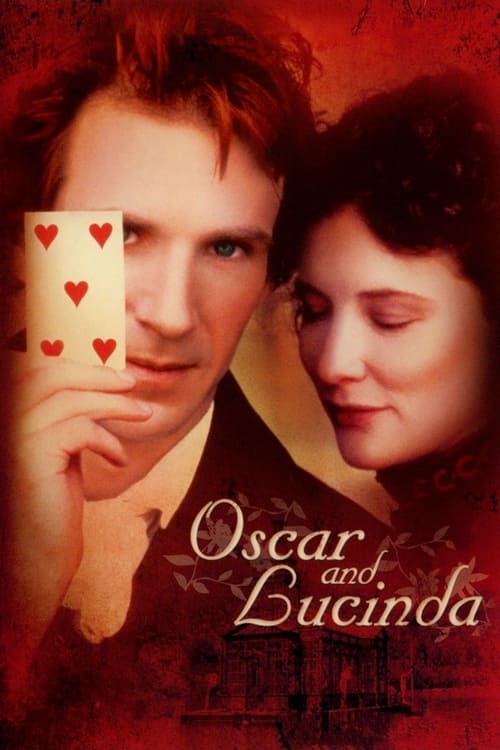
In mid-1800s England, Oscar is a young Anglican priest, a misfit and an outcast, but with the soul of an angel. As a boy, even though from a strict Pentecostal family, he felt God told him through a sign to leave his father and his faith and join the Church of England. Lucinda is a teen-aged Australian heiress who has an almost desperate desire to liberate her sex from the confines of the male-dominated culture of the Australia of that time. She buys a glass factory and has a dream of building a church made almost entirely of glass, and then transporting it to Bellingen, a remote settlement on the north coast. Oscar and Lucinda meet on a ship going to Australia; once there, they are for different reasons ostracized from society, and as a result "join forces" together. Oscar and Lucinda are both passionate gamblers, and Lucinda bets Oscar her entire inheritance that he cannot transport the glass church to the Outback safely. Oscar accepts her wager, and this leads to the events that will change both their lives forever.
Emotional fingerprint
Oscar and Lucinda (1997) — Movie. Top emotional signals: Empathy 30%, Sadness 25%, Love 20%. Source: AI estimate. Shares describe emotional signal, not percentages of people. Your experience may differ. How we measure
AI estimate · no viewer votes yet
How we measure
AI estimate
Share of emotional signal, not the percentage of people or a probability of enjoyment.
Each viewer contributes one response, split equally across their selected emotions. When available, an automated estimate supplies a prior that is blended with those responses. Counts include distinct viewers, not automated estimates or archived anonymous votes. Fewer than 3 viewers is an early estimate; more responses do not guarantee certainty.
Why it feels this way
The strongest emotional signals are Empathy, Sadness, Love. Genres: Drama, Romance. AI estimate.
Is it worth watching?
Consider this title if you are looking for Empathy, Sadness and Love. Its IMDb rating of 6.5/10 suggests a generally positive audience reception. For these leading emotions, its Feel Score is 67/100.
How did it make you feel?
Votes are saved to the fingerprint once you’re signed in.
Pick up to three · 0/3
Emotional journey
- Empathy
- Sadness
- Tension
Not enough subtitle evidence
No dominant emotion
Dominant emotion: Sadness
Dominant emotion: Humor
Dominant emotion: Empathy
Dominant emotion: Love
Dominant emotion: Tension
Dominant emotion
| % | Approximate minute | Dominant emotion | Overall intensity | Empathy | Sadness | Tension |
|---|---|---|---|---|---|---|
| 2.5 % | ≈ 3′ | Sadness | 55 % | 43 % | 43 % | 35 % |
| 7.5 % | ≈ 10′ | Humor | 49 % | 41 % | 30 % | 29 % |
| 12.5 % | ≈ 17′ | Empathy | 44 % | 39 % | 21 % | 26 % |
| 17.5 % | ≈ 23′ | Empathy | 43 % | 38 % | 20 % | 28 % |
| 22.5 % | ≈ 30′ | Love | 45 % | 40 % | 25 % | 30 % |
| 27.5 % | ≈ 36′ | Empathy | 48 % | 40 % | 27 % | 31 % |
| 32.5 % | ≈ 43′ | Humor | 45 % | 34 % | 19 % | 28 % |
| 37.5 % | ≈ 50′ | Love | 44 % | 34 % | 20 % | 26 % |
| 42.5 % | ≈ 56′ | Sadness | 51 % | 45 % | 38 % | 33 % |
| 47.5 % | ≈ 63′ | Empathy | 59 % | 54 % | 43 % | 41 % |
| 52.5 % | ≈ 69′ | Empathy | 59 % | 48 % | 26 % | 44 % |
| 57.5 % | ≈ 76′ | Love | 57 % | 38 % | 15 % | 45 % |
| 62.5 % | ≈ 83′ | Tension | 63 % | 40 % | 21 % | 55 % |
| 67.5 % | ≈ 89′ | Tension | 71 % | 48 % | 28 % | 66 % |
| 72.5 % | ≈ 96′ | Tension | 71 % | 51 % | 34 % | 64 % |
| 77.5 % | ≈ 102′ | Sadness | 69 % | 56 % | 50 % | 54 % |
| 82.5 % | ≈ 109′ | Sadness | 76 % | 65 % | 68 % | 53 % |
| 87.5 % | ≈ 116′ | Sadness | 81 % | 68 % | 71 % | 45 % |
| 92.5 % | ≈ 122′ | Love | 77 % | 62 % | 62 % | 27 % |
| 97.5 % | ≈ 129′ | Not enough subtitle evidence | Not enough subtitle evidence | Not enough subtitle evidence | Not enough subtitle evidence | Not enough subtitle evidence |
Riches to rags
Rags to riches: The emotional tone rises from negative to positive.
Riches to rags: The emotional tone falls from positive to negative.
Man in a hole: The tone falls, then recovers.
Icarus: The tone rises, then falls.
Cinderella: The tone rises, falls, then rises again.
Oedipus: The tone falls, rises, then falls again.
AI reading of the film’s English subtitles (dialogue and sound cues) — not viewer votes. How we measure ↗
Kadri — your film companion
AIAsk anything about Oscar and Lucinda. From the film’s own dialogue and FeelDB data, at your spoiler level.
Afterward Reveal viewer responses · may contain spoilers
Viewer responses about feelings after the title ended, separate from feelings while watching. No AI estimates.
0 responses so far
Feeling details appear after at least 3 viewers respond, to protect privacy.
Cast





Mr. Tomasetti

Elderly Parishoner
Miss Shaddock
Miriam Chadwick
Young Lucinda
Abel Leplastrier
Young Oscar
Details
- Directed by
- Gillian Armstrong
- Written by
- Peter Carey, Laura Jones
- Type
- Movies
- Released
- 1997
- Runtime
- 132 min
- Country
- United Kingdom, Australia, United States
- Ratings
- Feels mostly
- Empathy
- Data updated
Where to watch

Feels similar
More like this →Emotion overlap shows mood similarity, not a prediction of enjoyment.