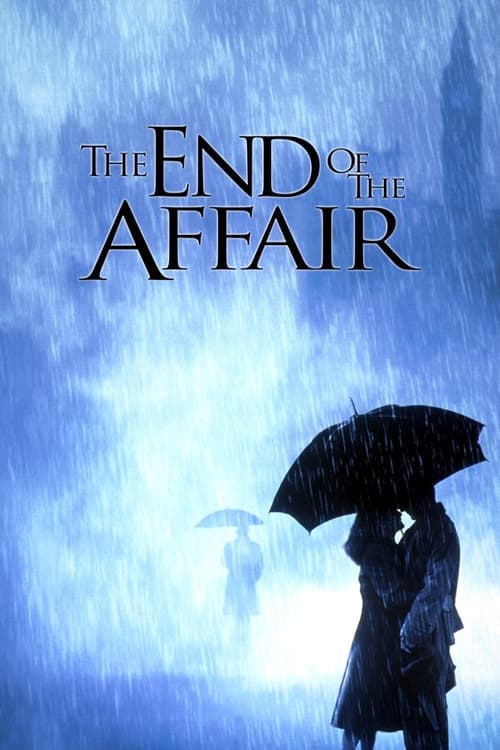
The End of the Affair
1999 · 102 min · Director: Neil Jordan
Show plot summary (may contain spoilers)
1946 London. One evening, novelist Maurice Bendrix runs into his old friend, mild-mannered government minister Henry Miles, who he has not seen in two years. Maurice met Henry and his wife Sarah Miles in 1939 when they were neighbors off the Common, Maurice using the notion of Henry as research for a character for one of his novels. The reason they have not seen each other in such a long time is that last meeting is when Sarah, without warning, abruptly ended her affair with Maurice, an affair of which Henry had and has no knowledge. This meeting at least brings Maurice back into the Miles' realm and again seeing Sarah. Maurice is as dismayed to hear as Henry is dismayed to tell that he believes Sarah currently is having an affair. Beyond still being in love with her, the deeper reason for Maurice's dismay is not only Sarah having professed her eternal love for him during the time they were together, but her vow that she would never sleep with another man, her and Henry's marriage, while one of emotional need, not of romantic love or sex. Stemming from a conversation between the two men, Maurice employs a detective agency to discover the nature of what Henry believes is Sarah's affair. In the process of discovering what Sarah has been doing, Maurice may discover what happened to end their affair and if she has been true to her word of her eternal love and sexual faithfulness to him.
Emotional fingerprint
The End of the Affair (1999) — Movie. Top emotional signals: Melancholy 35%, Love 25%, Sadness 20%. Source: AI estimate. Shares describe emotional signal, not percentages of people. Your experience may differ. How we measure
- Melancholy35%
- Love25%
- Sadness20%
- Anxiety10%
- Guilt10%
AI estimate · no viewer votes yet
How we measure
AI estimate
Share of emotional signal, not the percentage of people or a probability of enjoyment.
Each viewer contributes one response, split equally across their selected emotions. When available, an automated estimate supplies a prior that is blended with those responses. Counts include distinct viewers, not automated estimates or archived anonymous votes. Fewer than 3 viewers is an early estimate; more responses do not guarantee certainty.
Why it feels this way
The strongest emotional signals are Melancholy, Love, Sadness. Genres: Drama, Romance, Mystery. AI estimate.
Is it worth watching?
Consider this title if you are looking for Melancholy, Love and Sadness. Its IMDb rating of 7.0/10 suggests a generally positive audience reception. For these leading emotions, its Feel Score is 72/100.
How did it make you feel?
Votes are saved to the fingerprint once you’re signed in.
Pick up to three · 0/3
Emotional journey
- Sadness
- Love
- Empathy
Not enough subtitle evidence
No dominant emotion
Dominant emotion: Curiosity
Dominant emotion: Love
Dominant emotion: Sadness
Dominant emotion: Tension
Dominant emotion
| % | Approximate minute | Dominant emotion | Overall intensity | Sadness | Love | Empathy |
|---|---|---|---|---|---|---|
| 2.5 % | ≈ 3′ | Curiosity | 43 % | 18 % | 3 % | 17 % |
| 7.5 % | ≈ 8′ | Curiosity | 41 % | 14 % | 13 % | 16 % |
| 12.5 % | ≈ 13′ | Love | 45 % | 11 % | 32 % | 18 % |
| 17.5 % | ≈ 18′ | Love | 54 % | 24 % | 45 % | 28 % |
| 22.5 % | ≈ 23′ | Sadness | 55 % | 39 % | 38 % | 35 % |
| 27.5 % | ≈ 28′ | Curiosity | 53 % | 40 % | 34 % | 35 % |
| 32.5 % | ≈ 33′ | Love | 51 % | 32 % | 33 % | 33 % |
| 37.5 % | ≈ 38′ | Curiosity | 50 % | 25 % | 21 % | 31 % |
| 42.5 % | ≈ 43′ | Tension | 55 % | 25 % | 24 % | 36 % |
| 47.5 % | ≈ 48′ | Tension | 60 % | 30 % | 38 % | 39 % |
| 52.5 % | ≈ 54′ | Curiosity | 63 % | 40 % | 48 % | 45 % |
| 57.5 % | ≈ 59′ | Love | 65 % | 51 % | 53 % | 55 % |
| 62.5 % | ≈ 64′ | Sadness | 63 % | 58 % | 45 % | 56 % |
| 67.5 % | ≈ 69′ | Sadness | 60 % | 55 % | 41 % | 55 % |
| 72.5 % | ≈ 74′ | Love | 56 % | 38 % | 49 % | 46 % |
| 77.5 % | ≈ 79′ | Love | 56 % | 30 % | 55 % | 40 % |
| 82.5 % | ≈ 84′ | Love | 66 % | 49 % | 61 % | 54 % |
| 87.5 % | ≈ 89′ | Sadness | 76 % | 69 % | 59 % | 68 % |
| 92.5 % | ≈ 94′ | Sadness | 78 % | 73 % | 45 % | 68 % |
| 97.5 % | ≈ 99′ | Sadness | 72 % | 67 % | 37 % | 63 % |
Riches to rags
Rags to riches: The emotional tone rises from negative to positive.
Riches to rags: The emotional tone falls from positive to negative.
Man in a hole: The tone falls, then recovers.
Icarus: The tone rises, then falls.
Cinderella: The tone rises, falls, then rises again.
Oedipus: The tone falls, rises, then falls again.
AI reading of the film’s English subtitles (dialogue and sound cues) — not viewer votes. How we measure ↗
Afterward Reveal viewer responses · may contain spoilers
Viewer responses about feelings after the title ended, separate from feelings while watching. No AI estimates.
0 responses so far
Feeling details appear after at least 3 viewers respond, to protect privacy.
Cast






Lance Parkis
Dr Gilbert
Henry's Maid
Chief Engineer
Bendrix' Landlady
Doctor Gilbert
Brighton Fair-Goer (uncredited)
Bystander (uncredited)
Vicar on Train (uncredited)
Commanding Officer (uncredited)
Details
- Directed by
- Neil Jordan
- Written by
- Neil Jordan, Graham Greene
- Type
- Movies
- Released
- 1999
- Runtime
- 102 min
- Country
- United Kingdom, United States
- Ratings
- Feels mostly
- Melancholy
- Data updated
Where to watch

Rent


Feels similar
More like this →Emotion overlap shows mood similarity, not a prediction of enjoyment.