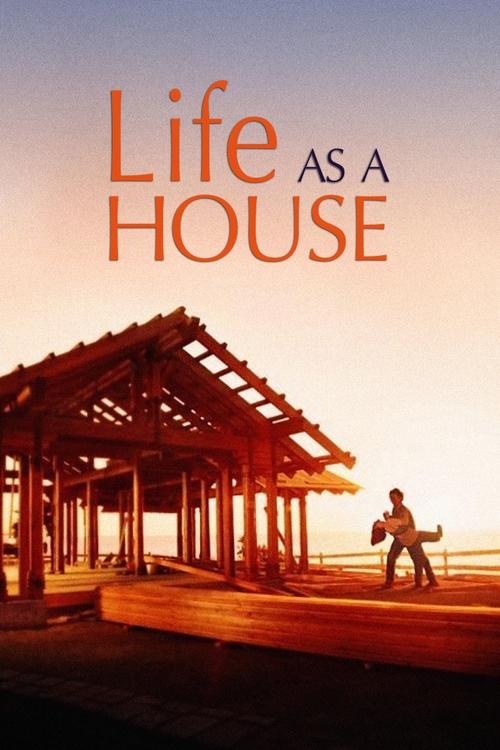
Life as a House
2001 · 125 min · Director: Irwin Winkler
Show plot summary (may contain spoilers)
George Monroe (Kevin Kline) is a lonely and sad man. Divorced for ten years, he lives alone on the southern California coast with his pet dog in the same run down shack in which he has lived for twenty-five years, the shack which his father passed down to him. In the intervening years, ostentatious houses have sprung up around him. He's been at the same architectural firm for twenty years in a job he hates, which primarily consists of building scale models. On the day that he is fired from his job, he is diagnosed with an advanced case of terminal cancer, which he chooses not to disclose to his family. In many ways, this day is the happiest of his recent life in that he decides to spend what little time he has left doing what he really wants to do, namely build a house he can call his own to replace the shack. He also wants his rebellious sixteen-year-old son, Sam Monroe (Hayden Christensen), to live with him for the summer, hopefully not only to help in the house construction, but for the two to reconnect as a family. Getting Sam to do any of it will not be an easy task as Sam, who has embarked on some self-destructive behavior, would rather do anything than spend time with his family, which also includes his mother Robin Kimball (Dame Kristin Scott Thomas), her wealthy but emotionally unaffectionate husband Peter Kimball (Jamey Sheridan), and their adolescent children. In Sam, George sees an unhappy person in every aspect of his life, much like George was before that fateful day. What Sam decides to do for the summer may consider Alyssa Beck (Jena Malone), his pretty classmate and George's next door neighbor. Through the process, George also reconnects with Robin, who admits that she's made some pretty bad decisions in her life. He may not want that reconnection to go too far considering his health. Ultimately, George has much to do to complete all he wants before he dies.
Emotional fingerprint
Life as a House (2001) — Movie. Top emotional signals: Sadness 30%, Empathy 25%, Hope 20%. Source: AI estimate. Shares describe emotional signal, not percentages of people. Your experience may differ. How we measure
- Sadness30%
- Empathy25%
- Hope20%
- Love15%
- Satisfaction10%
AI estimate · no viewer votes yet
How we measure
AI estimate
Share of emotional signal, not the percentage of people or a probability of enjoyment.
Each viewer contributes one response, split equally across their selected emotions. When available, an automated estimate supplies a prior that is blended with those responses. Counts include distinct viewers, not automated estimates or archived anonymous votes. Fewer than 3 viewers is an early estimate; more responses do not guarantee certainty.
Why it feels this way
The strongest emotional signals are Sadness, Empathy, Hope. Genres: Drama. AI estimate.
Is it worth watching?
Consider this title if you are looking for Sadness, Empathy and Hope. Its IMDb rating of 7.4/10 suggests a generally positive audience reception. For these leading emotions, its Feel Score is 73/100.
How did it make you feel?
Votes are saved to the fingerprint once you’re signed in.
Pick up to three · 0/3
Emotional journey
- Sadness
- Empathy
- Hope
Not enough subtitle evidence
No dominant emotion
Dominant emotion: Humor
Dominant emotion: Tension
Dominant emotion: Sadness
Dominant emotion: Empathy
Dominant emotion: Hope
Dominant emotion
| % | Approximate minute | Dominant emotion | Overall intensity | Sadness | Empathy | Hope |
|---|---|---|---|---|---|---|
| 2.5 % | ≈ 3′ | Humor | 38 % | 15 % | 20 % | 2 % |
| 7.5 % | ≈ 9′ | Tension | 46 % | 26 % | 30 % | 4 % |
| 12.5 % | ≈ 16′ | Tension | 57 % | 44 % | 45 % | 11 % |
| 17.5 % | ≈ 22′ | Sadness | 63 % | 46 % | 48 % | 19 % |
| 22.5 % | ≈ 28′ | Tension | 55 % | 28 % | 33 % | 16 % |
| 27.5 % | ≈ 34′ | Humor | 48 % | 19 % | 30 % | 19 % |
| 32.5 % | ≈ 41′ | Empathy | 49 % | 24 % | 38 % | 25 % |
| 37.5 % | ≈ 47′ | Tension | 52 % | 24 % | 34 % | 18 % |
| 42.5 % | ≈ 53′ | Tension | 56 % | 25 % | 33 % | 16 % |
| 47.5 % | ≈ 59′ | Hope | 55 % | 28 % | 38 % | 35 % |
| 52.5 % | ≈ 66′ | Hope | 56 % | 34 % | 44 % | 41 % |
| 57.5 % | ≈ 72′ | Sadness | 59 % | 40 % | 48 % | 30 % |
| 62.5 % | ≈ 78′ | Empathy | 54 % | 33 % | 44 % | 26 % |
| 67.5 % | ≈ 84′ | Humor | 51 % | 29 % | 39 % | 23 % |
| 72.5 % | ≈ 91′ | Sadness | 61 % | 46 % | 48 % | 18 % |
| 77.5 % | ≈ 97′ | Sadness | 75 % | 65 % | 65 % | 24 % |
| 82.5 % | ≈ 103′ | Empathy | 80 % | 68 % | 74 % | 36 % |
| 87.5 % | ≈ 109′ | Empathy | 80 % | 66 % | 73 % | 46 % |
| 92.5 % | ≈ 116′ | Sadness | 80 % | 68 % | 68 % | 52 % |
| 97.5 % | ≈ 122′ | Not enough subtitle evidence | Not enough subtitle evidence | Not enough subtitle evidence | Not enough subtitle evidence | Not enough subtitle evidence |
Icarus
Rags to riches: The emotional tone rises from negative to positive.
Riches to rags: The emotional tone falls from positive to negative.
Man in a hole: The tone falls, then recovers.
Icarus: The tone rises, then falls.
Cinderella: The tone rises, falls, then rises again.
Oedipus: The tone falls, rises, then falls again.
AI reading of the film’s English subtitles (dialogue and sound cues) — not viewer votes. How we measure ↗
Afterward Reveal viewer responses · may contain spoilers
Viewer responses about feelings after the title ended, separate from feelings while watching. No AI estimates.
0 responses so far
Feeling details appear after at least 3 viewers respond, to protect privacy.
Cast







Nurse

Adam Kimball
Ryan Kimball

Bob Larson

Details
- Directed by
- Irwin Winkler
- Written by
- Mark Andrus
- Type
- Movies
- Released
- 2001
- Runtime
- 125 min
- Country
- United States
- Genres
- Drama
- Ratings
- Feels mostly
- Sadness
- Data updated
Where to watch
Rent


Feels similar
More like this →Emotion overlap shows mood similarity, not a prediction of enjoyment.