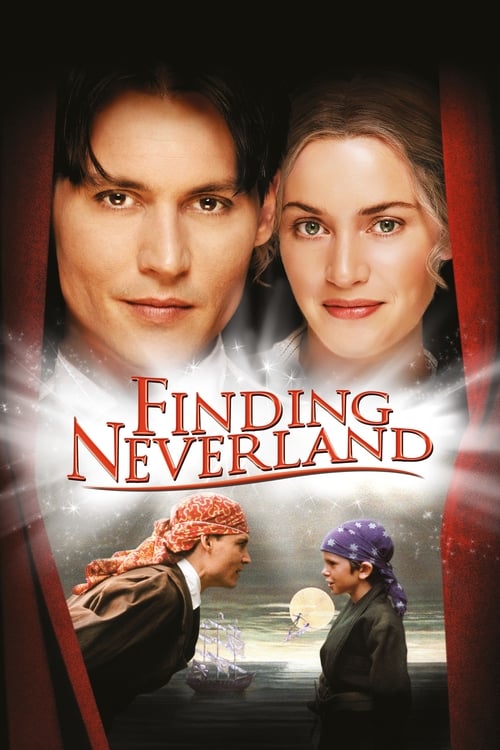
Finding Neverland
2004 · 106 min · Director: Marc Forster
Show plot summary (may contain spoilers)
1903 London. Renowned playwright J.M. Barrie (James)'s latest effort has garnered less than positive reviews, something he knew would be the case even before the play's mounting. This failure places pressure on James to write another play quickly as impresario Charles Frohman needs another to replace the failure to keep his theater viable. Out for a walk with his dog in part to let his creative juices flow, James stumbles upon the Llewelyn Davies family: recently widowed Sylvia Llewelyn Davies (the daughter of now deceased author George L. Du Maurier) and her four adolescent sons. James and the family members become friends, largely based on he and the boys being able to foster in each other the imagination of children, James just being the biggest among them in this regard. Sylvia also welcomes James into their lives, he who becomes an important and integral part of it. Among the six of them, the only one who does not want to partake is Sylvia's third, Peter Llewelyn Davies, who is still grieving the reality of their lives, where his father was there one day planning an outing for the family, and gone the next. Two other people who don't appreciate James in the Llewelyn Davies' lives are: his wife, Mary Barrie, who always feels the need to be the responsible one in their relationship and who feels threatened by his friendship with an unmarried woman; and Emma du Maurier, Sylvia's overbearing mother, who sees him as an obstacle to Sylvia moving on with her life with another potential husband, and an impediment to maintaining discipline within the boys. James still hopes to bring Peter out of his self-imposed shell, but in the process comes up with an idea for another play based on an amalgam of himself and Peter, that play which eventually becomes what Charles sees as a largely unmountable and thus doomed production called "Peter Pan". This process of helping Peter could take a step backward when it looks like Sylvia may imminently befall a similar fate to that of her late husband.
Emotional fingerprint
Finding Neverland (2004) — Movie. Top emotional signals: Empathy 30%, Sadness 25%, Inspiration 20%. Source: AI estimate. Shares describe emotional signal, not percentages of people. Your experience may differ. How we measure
- Empathy30%
- Sadness25%
- Inspiration20%
- Love15%
- Hope10%
AI estimate · no viewer votes yet
How we measure
AI estimate
Share of emotional signal, not the percentage of people or a probability of enjoyment.
Each viewer contributes one response, split equally across their selected emotions. When available, an automated estimate supplies a prior that is blended with those responses. Counts include distinct viewers, not automated estimates or archived anonymous votes. Fewer than 3 viewers is an early estimate; more responses do not guarantee certainty.
Why it feels this way
The strongest emotional signals are Empathy, Sadness, Inspiration. Genres: Drama, Family, Biography. AI estimate.
Is it worth watching?
Consider this title if you are looking for Empathy, Sadness and Inspiration. Its IMDb rating of 7.6/10 suggests a generally positive audience reception. For these leading emotions, its Feel Score is 73/100.
How did it make you feel?
Votes are saved to the fingerprint once you’re signed in.
Pick up to three · 0/3
Emotional journey
- Sadness
- Empathy
- Hope
Not enough subtitle evidence
No dominant emotion
Dominant emotion: Humor
Dominant emotion: Empathy
Dominant emotion: Hope
Dominant emotion: Sadness
Dominant emotion: Tension
Dominant emotion
| % | Approximate minute | Dominant emotion | Overall intensity | Sadness | Empathy | Hope |
|---|---|---|---|---|---|---|
| 2.5 % | ≈ 3′ | Humor | 33 % | 10 % | 15 % | 14 % |
| 7.5 % | ≈ 8′ | Humor | 38 % | 17 % | 24 % | 19 % |
| 12.5 % | ≈ 13′ | Empathy | 41 % | 24 % | 33 % | 23 % |
| 17.5 % | ≈ 19′ | Humor | 41 % | 20 % | 32 % | 27 % |
| 22.5 % | ≈ 24′ | Hope | 43 % | 14 % | 29 % | 32 % |
| 27.5 % | ≈ 29′ | Hope | 48 % | 26 % | 38 % | 33 % |
| 32.5 % | ≈ 34′ | Sadness | 50 % | 31 % | 38 % | 28 % |
| 37.5 % | ≈ 40′ | Humor | 49 % | 22 % | 29 % | 21 % |
| 42.5 % | ≈ 45′ | Tension | 55 % | 34 % | 40 % | 15 % |
| 47.5 % | ≈ 50′ | Sadness | 64 % | 55 % | 56 % | 13 % |
| 52.5 % | ≈ 56′ | Sadness | 61 % | 52 % | 54 % | 14 % |
| 57.5 % | ≈ 61′ | Tension | 56 % | 43 % | 48 % | 20 % |
| 62.5 % | ≈ 66′ | Sadness | 56 % | 39 % | 49 % | 27 % |
| 67.5 % | ≈ 72′ | Hope | 58 % | 39 % | 53 % | 37 % |
| 72.5 % | ≈ 77′ | Empathy | 65 % | 50 % | 60 % | 40 % |
| 77.5 % | ≈ 82′ | Sadness | 69 % | 57 % | 63 % | 41 % |
| 82.5 % | ≈ 87′ | Hope | 73 % | 59 % | 65 % | 49 % |
| 87.5 % | ≈ 93′ | Sadness | 80 % | 70 % | 73 % | 49 % |
| 92.5 % | ≈ 98′ | Not enough subtitle evidence | Not enough subtitle evidence | Not enough subtitle evidence | Not enough subtitle evidence | Not enough subtitle evidence |
| 97.5 % | ≈ 103′ | Not enough subtitle evidence | Not enough subtitle evidence | Not enough subtitle evidence | Not enough subtitle evidence | Not enough subtitle evidence |
AI reading of the film’s English subtitles (dialogue and sound cues) — not viewer votes. How we measure ↗
Kadri — your film companion
AIAsk anything about Finding Neverland. From the film’s own dialogue and FeelDB data, at your spoiler level.
Afterward Reveal viewer responses · may contain spoilers
Viewer responses about feelings after the title ended, separate from feelings while watching. No AI estimates.
0 responses so far
Feeling details appear after at least 3 viewers respond, to protect privacy.
Cast






Jack Llewelyn Davies
George Llewelyn Davies
Michael Llewelyn Davies



Theater Patron 3

Details
- Directed by
- Marc Forster
- Written by
- Allan Knee, David Magee
- Type
- Movies
- Released
- 2004
- Runtime
- 106 min
- Country
- United States, United Kingdom
- Ratings
- Feels mostly
- Empathy
- Data updated
Where to watch


Rent


Feels similar
More like this →Emotion overlap shows mood similarity, not a prediction of enjoyment.