
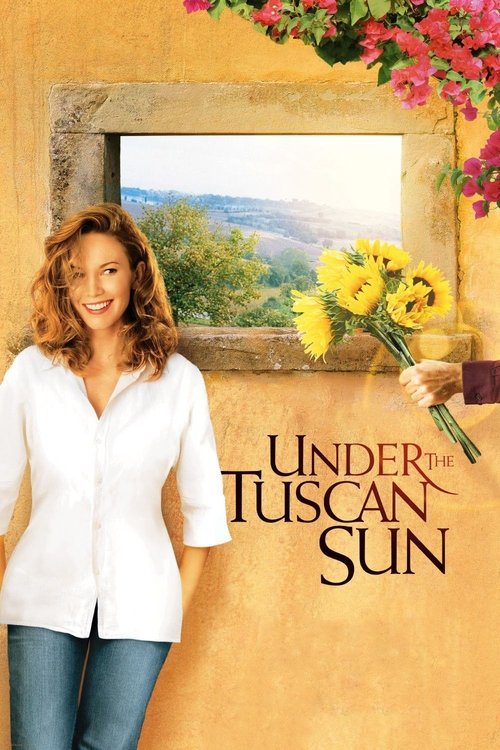
Under the Tuscan Sun
2003 · 113 min · Director: Audrey Wells
Show plot summary (may contain spoilers)
Frances Mayes is a San Francisco-based literature professor, literary reviewer and author, who is struggling in writing her latest book. Her outwardly perfect and stable life takes an unexpected turn when her husband files for divorce. He wants to marry the woman with whom he is having an affair. Frances supported her husband financially as he was writing his own book, and he sues her for alimony despite her financial difficulties. And he wants to keep the house. Frances eventually accepts her best friend Patti's offer of a vacation, a gay tour of Tuscany which Patti and her lesbian partner Grace originally purchased for themselves before Patti found out that she is pregnant. The gift is a means to escape dealing with the divorce, from which Patti feels Frances may never recover emotionally without some intervention. Feeling that Patti's assessment may be correct in that she has too much emotional baggage ever to return to San Francisco, Frances, while in Tuscany, impulsively ditches the tour to purchase an aged villa, which ends up being a fixer-upper. Frances has many obstacles in eking out a productive and happy life in her new surroundings, that happy life which she hopes will eventually include rediscovering romantic love. In a discussion with sympathetic real estate agent Signor Martini, Frances outlines what emotionally she wants to accomplish with the villa, despite none of those items in a substantive material sense currently being in her life. In response, Martini tells her the story of a set of railroad tracks that were laid between Vienna and Venice before an engine that could make the trek being built, a train which now regularly travels the route. The question becomes whether Frances, in going through the process, will be laying another Vienna to Venice track, and if so whether that end product emotionally will be exactly as she envisions.
Emotional fingerprint
Under the Tuscan Sun (2003) — Movie. Top emotional signals: Hope 30%, Joy 25%, Love 20%. Source: AI estimate. Shares describe emotional signal, not percentages of people. Your experience may differ. How we measure
- Hope30%
- Joy25%
- Love20%
- Nostalgia15%
- Satisfaction10%
AI estimate · no viewer votes yet
How we measure
AI estimate
Share of emotional signal, not the percentage of people or a probability of enjoyment.
Each viewer contributes one response, split equally across their selected emotions. When available, an automated estimate supplies a prior that is blended with those responses. Counts include distinct viewers, not automated estimates or archived anonymous votes. Fewer than 3 viewers is an early estimate; more responses do not guarantee certainty.
Why it feels this way
The strongest emotional signals are Hope, Joy, Love. Genres: Comedy, Drama, Romance. AI estimate.
Is it worth watching?
Consider this title if you are looking for Hope, Joy and Love. Its IMDb rating of 6.8/10 suggests a generally positive audience reception. For these leading emotions, its Feel Score is 70/100.
How did it make you feel?
Votes are saved to the fingerprint once you’re signed in.
Pick up to three · 0/3
Emotional journey
- Joy
- Hope
- Love
Not enough subtitle evidence
No dominant emotion
Dominant emotion: Sadness
Dominant emotion: Hope
Dominant emotion: Humor
Dominant emotion: Love
Dominant emotion: Joy
Dominant emotion
| % | Approximate minute | Dominant emotion | Overall intensity | Joy | Hope | Love |
|---|---|---|---|---|---|---|
| 2.5 % | ≈ 3′ | Sadness | 47 % | 13 % | 12 % | 12 % |
| 7.5 % | ≈ 8′ | Sadness | 48 % | 15 % | 23 % | 13 % |
| 12.5 % | ≈ 14′ | Sadness | 45 % | 23 % | 32 % | 10 % |
| 17.5 % | ≈ 20′ | Hope | 43 % | 24 % | 31 % | 6 % |
| 22.5 % | ≈ 25′ | Sadness | 44 % | 16 % | 25 % | 6 % |
| 27.5 % | ≈ 31′ | Humor | 45 % | 15 % | 23 % | 10 % |
| 32.5 % | ≈ 37′ | Humor | 48 % | 18 % | 20 % | 15 % |
| 37.5 % | ≈ 42′ | Sadness | 53 % | 20 % | 26 % | 20 % |
| 42.5 % | ≈ 48′ | Hope | 51 % | 25 % | 38 % | 21 % |
| 47.5 % | ≈ 54′ | Humor | 45 % | 29 % | 34 % | 21 % |
| 52.5 % | ≈ 59′ | Humor | 48 % | 35 % | 31 % | 34 % |
| 57.5 % | ≈ 65′ | Love | 56 % | 45 % | 36 % | 48 % |
| 62.5 % | ≈ 71′ | Joy | 57 % | 48 % | 34 % | 43 % |
| 67.5 % | ≈ 76′ | Humor | 53 % | 43 % | 28 % | 36 % |
| 72.5 % | ≈ 82′ | Joy | 53 % | 34 % | 21 % | 35 % |
| 77.5 % | ≈ 88′ | Sadness | 55 % | 21 % | 21 % | 26 % |
| 82.5 % | ≈ 93′ | Sadness | 56 % | 28 % | 35 % | 30 % |
| 87.5 % | ≈ 99′ | Joy | 63 % | 50 % | 51 % | 48 % |
| 92.5 % | ≈ 105′ | Hope | 68 % | 60 % | 60 % | 53 % |
| 97.5 % | ≈ 110′ | Not enough subtitle evidence | Not enough subtitle evidence | Not enough subtitle evidence | Not enough subtitle evidence | Not enough subtitle evidence |
Rags to riches
Rags to riches: The emotional tone rises from negative to positive.
Riches to rags: The emotional tone falls from positive to negative.
Man in a hole: The tone falls, then recovers.
Icarus: The tone rises, then falls.
Cinderella: The tone rises, falls, then rises again.
Oedipus: The tone falls, rises, then falls again.
AI reading of the film’s English subtitles (dialogue and sound cues) — not viewer votes. How we measure ↗
Kadri — your film companion
AIAsk anything about Under the Tuscan Sun. From the film’s own dialogue and FeelDB data, at your spoiler level.
Afterward Reveal viewer responses · may contain spoilers
Viewer responses about feelings after the title ended, separate from feelings while watching. No AI estimates.
0 responses so far
Feeling details appear after at least 3 viewers respond, to protect privacy.
Cast





Zbignew

Head Mover
Seat Mate
Gianni
Details
- Directed by
- Audrey Wells
- Written by
- Audrey Wells, Frances Mayes
- Type
- Movies
- Released
- 2003
- Runtime
- 113 min
- Country
- United States, Italy
- Ratings
- Feels mostly
- Hope
- Data updated
Where to watch
Subscription

Rent


Also on
Availability varies by country
Feels similar
More like this →Emotion overlap shows mood similarity, not a prediction of enjoyment.


