Seabiscuit
2003 · 141 min · Director: Gary Ross
Show plot summary (may contain spoilers)
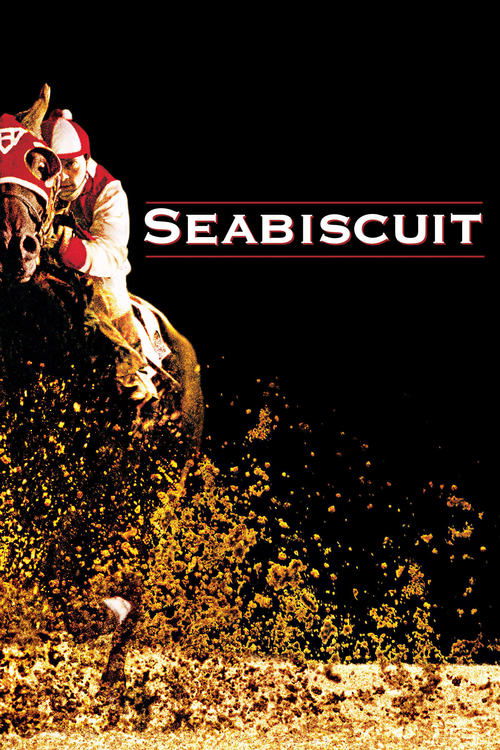
It's the Depression, and everyone needs to hold onto a dream to get them through the bad times. Car maker Charles Howard is no different, he who is trying to rebuild his life after the tragic death of his only child and the resulting end of his first marriage. With second wife Marcela at his side, Charles wants to get into horse racing and ends up with a team of underdogs who are also chasing their own dream. The first is trainer Tom Smith, who has a natural instinct to spot the capabilities of horses. The second is the horse Tom chooses for Charles, Seabiscuit, an unconventional choice as despite his pedigreed lineage, Seabiscuit is small at fifteen and a half hands tall with a slight limp. But Tom can see something in Seabiscuit's nature to make him a winner, if only Seabiscuit can be retrained from his inbred losing ways. And third is the jockey they decide to hire, Johnny "Red" Pollard, so nicknamed because of his hair color. Like Tom, Red has always shown a natural way with horses, but a difficult upbringing due solely to the Depression has made Red an angry young man, which has gotten him into trouble both on and off the track. And he is large for a jockey, and thus he always feels the need to battle the weight issue. Another common trait between Tom, Seabiscuit and Red is that they have been called crazy by those in traditional horse racing circles. Against the odds, Seabiscuit, with his human team behind him, does show his winning abilities and captures the imagination of all those others wanting to believe in a dream. But Seabiscuit's victories are at smaller races. As such, Charles aims high and wants Seabiscuit to race Triple Crown winner War Admiral, who by all accounts is a winner and should be a winner. If given the chance to race against War Admiral (whose owner doesn't want to race as he feels he has nothing to prove), will Seabiscuit and his team continue to keep the dreams of the common Americans alive? Through the good and the bad, especially as Red and Seabiscuit face mirroring problems, they all have to decide what is in their collective best interest.
Emotional fingerprint
Seabiscuit (2003) — Movie. Top emotional signals: Inspiration 30%, Excitement 25%, Empathy 20%. Source: AI estimate. Shares describe emotional signal, not percentages of people. Your experience may differ. How we measure
- Inspiration30%
- Excitement25%
- Empathy20%
- Love15%
- Satisfaction10%
AI estimate · no viewer votes yet
How we measure
AI estimate
Share of emotional signal, not the percentage of people or a probability of enjoyment.
Each viewer contributes one response, split equally across their selected emotions. When available, an automated estimate supplies a prior that is blended with those responses. Counts include distinct viewers, not automated estimates or archived anonymous votes. Fewer than 3 viewers is an early estimate; more responses do not guarantee certainty.
Why it feels this way
The strongest emotional signals are Inspiration, Excitement, Empathy. Genres: Drama, History, Sport. AI estimate.
Is it worth watching?
Consider this title if you are looking for Inspiration, Excitement and Empathy. Its IMDb rating of 7.3/10 suggests a generally positive audience reception. For these leading emotions, its Feel Score is 72/100.
How did it make you feel?
Votes are saved to the fingerprint once you’re signed in.
Pick up to three · 0/3
Emotional journey
- Hope
- Empathy
- Tension
Not enough subtitle evidence
No dominant emotion
Dominant emotion: Hope
Dominant emotion: Sadness
Dominant emotion: Empathy
Dominant emotion: Joy
Dominant emotion: Tension
Dominant emotion
| % | Approximate minute | Dominant emotion | Overall intensity | Hope | Empathy | Tension |
|---|---|---|---|---|---|---|
| 2.5 % | ≈ 4′ | Hope | 37 % | 37 % | 10 % | 8 % |
| 7.5 % | ≈ 11′ | Hope | 46 % | 31 % | 23 % | 21 % |
| 12.5 % | ≈ 18′ | Sadness | 56 % | 18 % | 40 % | 39 % |
| 17.5 % | ≈ 25′ | Sadness | 50 % | 13 % | 39 % | 41 % |
| 22.5 % | ≈ 32′ | Empathy | 44 % | 20 % | 38 % | 30 % |
| 27.5 % | ≈ 39′ | Empathy | 48 % | 25 % | 46 % | 24 % |
| 32.5 % | ≈ 46′ | Empathy | 53 % | 32 % | 51 % | 25 % |
| 37.5 % | ≈ 53′ | Hope | 55 % | 46 % | 46 % | 25 % |
| 42.5 % | ≈ 60′ | Hope | 55 % | 51 % | 36 % | 34 % |
| 47.5 % | ≈ 67′ | Hope | 59 % | 51 % | 31 % | 41 % |
| 52.5 % | ≈ 74′ | Joy | 64 % | 49 % | 35 % | 43 % |
| 57.5 % | ≈ 81′ | Empathy | 64 % | 48 % | 44 % | 44 % |
| 62.5 % | ≈ 88′ | Hope | 61 % | 49 % | 48 % | 39 % |
| 67.5 % | ≈ 95′ | Empathy | 65 % | 48 % | 45 % | 46 % |
| 72.5 % | ≈ 102′ | Tension | 73 % | 46 % | 40 % | 57 % |
| 77.5 % | ≈ 109′ | Joy | 71 % | 46 % | 43 % | 44 % |
| 82.5 % | ≈ 116′ | Hope | 68 % | 54 % | 49 % | 36 % |
| 87.5 % | ≈ 123′ | Hope | 70 % | 60 % | 56 % | 50 % |
| 92.5 % | ≈ 130′ | Hope | 73 % | 62 % | 65 % | 55 % |
| 97.5 % | ≈ 137′ | Not enough subtitle evidence | Not enough subtitle evidence | Not enough subtitle evidence | Not enough subtitle evidence | Not enough subtitle evidence |
Rags to riches
Rags to riches: The emotional tone rises from negative to positive.
Riches to rags: The emotional tone falls from positive to negative.
Man in a hole: The tone falls, then recovers.
Icarus: The tone rises, then falls.
Cinderella: The tone rises, falls, then rises again.
Oedipus: The tone falls, rises, then falls again.
AI reading of the film’s English subtitles (dialogue and sound cues) — not viewer votes. How we measure ↗
Kadri — your film companion
AIAsk anything about Seabiscuit. From the film’s own dialogue and FeelDB data, at your spoiler level.
Afterward Reveal viewer responses · may contain spoilers
Viewer responses about feelings after the title ended, separate from feelings while watching. No AI estimates.
0 responses so far
Feeling details appear after at least 3 viewers respond, to protect privacy.
Cast

Narrator



George Woolf


Charley Kurtsinger

Bicycle Supervisor



Pimlico Starter
Details
Where to watch


Rent


Feels similar
More like this →Emotion overlap shows mood similarity, not a prediction of enjoyment.