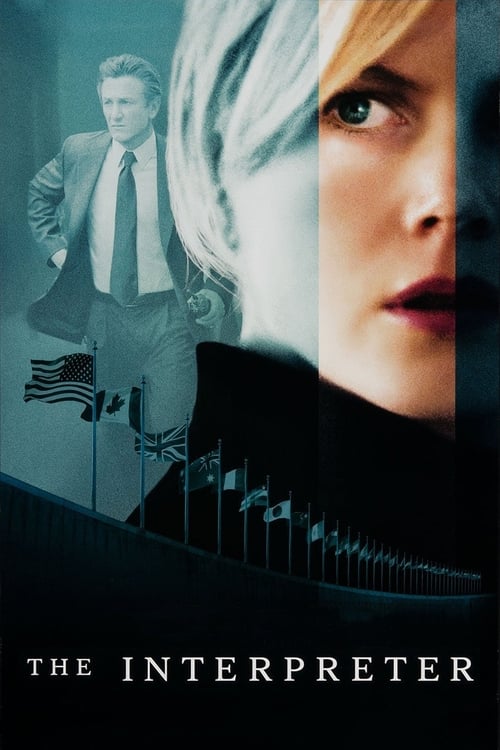
The Interpreter
2005 · 128 min · Director: Sydney Pollack
Show plot summary (may contain spoilers)
Escalating events begin when U.N. interpreter Silvia Broome alleges that she has overheard a death threat against an African head of state, spoken in a rare dialect few people other than Silvia can understand. With the words "The Teacher will never leave this room alive," in an instant, Silvia's life is turned upside down as she becomes a hunted target of the killers. Placed under the protection of federal agent Tobin Keller, Silvia's world only grows more nightmarish. As Keller digs deeper into his eyewitnesses' past and her secretive world of global connections, the more suspicious he becomes that she herself might be involved in the conspiracy. With every step of the way, he finds more reasons to mistrust her. Is Sylvia a victim? A suspect? Or something else entirely? And can Tobin, coping with his own personal heartache, keep her safe? Though they must depend on one another, Silvia and Tobin couldn't be more different. Silvia's strengths are words, diplomacy and the subtleties of meaning, while Tobin is all about instinct, action and reading into the most primal human behaviors. Now, as the danger of a major assassination on U.S. soil grows and Silvia's life hangs in the balance, Silvia and Tobin play out a gripping dance of evasion and revelation that keeps them both guessing as they race to stop a terrifying international crisis before it's too late.
Emotional fingerprint
The Interpreter (2005) — Movie. Top emotional signals: Anxiety 30%, Anticipation 25%, Confusion 20%. Source: AI estimate. Shares describe emotional signal, not percentages of people. Your experience may differ. How we measure
- Anxiety30%
- Anticipation25%
- Confusion20%
- Tension15%
- Empathy10%
AI estimate · no viewer votes yet
How we measure
AI estimate
Share of emotional signal, not the percentage of people or a probability of enjoyment.
Each viewer contributes one response, split equally across their selected emotions. When available, an automated estimate supplies a prior that is blended with those responses. Counts include distinct viewers, not automated estimates or archived anonymous votes. Fewer than 3 viewers is an early estimate; more responses do not guarantee certainty.
Why it feels this way
The strongest emotional signals are Anxiety, Anticipation, Confusion. Genres: Thriller, Mystery, Crime. AI estimate.
Is it worth watching?
Consider this title if you are looking for Anxiety, Anticipation and Confusion. Its IMDb rating of 6.4/10 suggests a generally positive audience reception. For these leading emotions, its Feel Score is 67/100.
How did it make you feel?
Votes are saved to the fingerprint once you’re signed in.
Pick up to three · 0/3
Emotional journey
- Tension
- Sadness
- Empathy
Not enough subtitle evidence
No dominant emotion
Dominant emotion: Tension
Dominant emotion: Curiosity
Dominant emotion: Sadness
Dominant emotion: Empathy
Dominant emotion
| % | Approximate minute | Dominant emotion | Overall intensity | Tension | Sadness | Empathy |
|---|---|---|---|---|---|---|
| 2.5 % | ≈ 3′ | Tension | 57 % | 57 % | 17 % | 15 % |
| 7.5 % | ≈ 10′ | Tension | 53 % | 53 % | 11 % | 11 % |
| 12.5 % | ≈ 16′ | Tension | 55 % | 51 % | 11 % | 11 % |
| 17.5 % | ≈ 22′ | Curiosity | 54 % | 44 % | 10 % | 11 % |
| 22.5 % | ≈ 29′ | Curiosity | 49 % | 36 % | 9 % | 11 % |
| 27.5 % | ≈ 35′ | Curiosity | 51 % | 38 % | 23 % | 24 % |
| 32.5 % | ≈ 42′ | Sadness | 60 % | 41 % | 49 % | 48 % |
| 37.5 % | ≈ 48′ | Sadness | 63 % | 40 % | 59 % | 58 % |
| 42.5 % | ≈ 54′ | Sadness | 60 % | 43 % | 53 % | 51 % |
| 47.5 % | ≈ 61′ | Sadness | 63 % | 49 % | 54 % | 51 % |
| 52.5 % | ≈ 67′ | Sadness | 69 % | 56 % | 50 % | 51 % |
| 57.5 % | ≈ 74′ | Tension | 78 % | 66 % | 48 % | 51 % |
| 62.5 % | ≈ 80′ | Sadness | 83 % | 56 % | 66 % | 65 % |
| 67.5 % | ≈ 86′ | Sadness | 80 % | 45 % | 68 % | 70 % |
| 72.5 % | ≈ 93′ | Tension | 74 % | 56 % | 41 % | 54 % |
| 77.5 % | ≈ 99′ | Curiosity | 71 % | 68 % | 25 % | 34 % |
| 82.5 % | ≈ 106′ | Tension | 78 % | 76 % | 28 % | 31 % |
| 87.5 % | ≈ 112′ | Tension | 85 % | 80 % | 49 % | 53 % |
| 92.5 % | ≈ 118′ | Sadness | 83 % | 57 % | 68 % | 70 % |
| 97.5 % | ≈ 125′ | Empathy | 73 % | 27 % | 65 % | 70 % |
Man in a hole
Rags to riches: The emotional tone rises from negative to positive.
Riches to rags: The emotional tone falls from positive to negative.
Man in a hole: The tone falls, then recovers.
Icarus: The tone rises, then falls.
Cinderella: The tone rises, falls, then rises again.
Oedipus: The tone falls, rises, then falls again.
AI reading of the film’s English subtitles (dialogue and sound cues) — not viewer votes. How we measure ↗
Kadri — your film companion
AIAsk anything about The Interpreter. From the film’s own dialogue and FeelDB data, at your spoiler level.
Afterward Reveal viewer responses · may contain spoilers
Viewer responses about feelings after the title ended, separate from feelings while watching. No AI estimates.
0 responses so far
Feeling details appear after at least 3 viewers respond, to protect privacy.
Cast







Mo
Doug
Jean Gamba
Fred Jameson

Details
- Directed by
- Sydney Pollack
- Written by
- Martin Stellman, Steven Zaillian, Scott Frank, Charles Randolph, Brian Ward
- Type
- Movies
- Released
- 2005
- Runtime
- 128 min
- Country
- United Kingdom, France, Germany, United States
- Ratings
- Feels mostly
- Anxiety
- Data updated
Where to watch


Rent


Feels similar
More like this →Emotion overlap shows mood similarity, not a prediction of enjoyment.