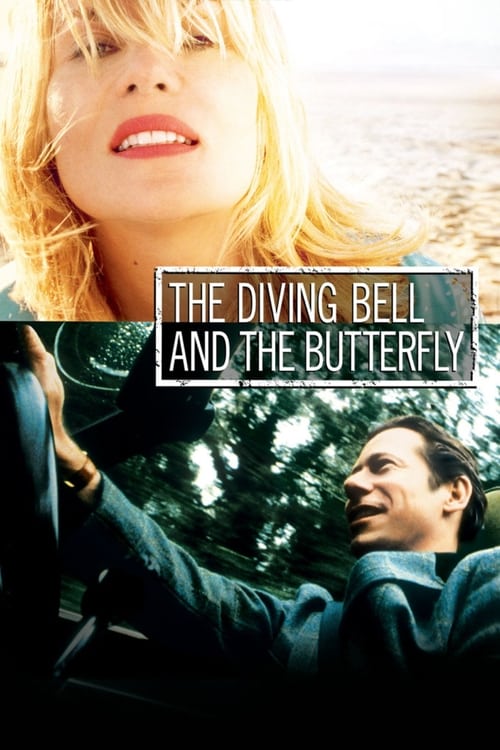
The Diving Bell and the Butterfly
2007 · 112 min · Director: Julian Schnabel
Show plot summary (may contain spoilers)
Forty-three year old Elle magazine editor Jean-Dominique Bauby - Jean-Do to his friends - awakens not knowing where he is. He is in a Berck-sur-Mer hospital, where he has been for the past several weeks in a coma after suffering a massive stroke. Although his cognitive facilities are intact, he quickly learns that he has what is called locked-in syndrome which has resulted in him being almost completely paralyzed, including not being able to speak. One of his few functioning muscles is his left eye. His physical situation and hospitalization uncomfortably bring together the many people in his life, including: Céline Desmoulins, his ex-lover and mother of his children; Inès, his current lover; and his aged father who he calls Papinou. Among his compassionate recuperative team are his physical therapist Marie, and his speech therapist Henriette. Henriette eventually teaches him to communicate using a system where he spells out words: she reads out the letters of the alphabet in descending order of their use in the French language, and he blinks his functioning left eye when she reaches the appropriate letter. Although frustrating at start, he learns to communicate effectively but slowly using this method, so much so that with the help of Claude, a full time translator, he decides on the monumental and seemingly impossible task to keep to his pre-injury commitment of writing a book, changing its focus to life in his current state.
Emotional fingerprint
The Diving Bell and the Butterfly (2007) — Movie. Top emotional signals: Sadness 35%, Empathy 25%, Melancholy 20%. Source: AI estimate. Shares describe emotional signal, not percentages of people. Your experience may differ. How we measure
- Sadness35%
- Empathy25%
- Melancholy20%
- Relief10%
- Awe10%
AI estimate · no viewer votes yet
How we measure
AI estimate
Share of emotional signal, not the percentage of people or a probability of enjoyment.
Each viewer contributes one response, split equally across their selected emotions. When available, an automated estimate supplies a prior that is blended with those responses. Counts include distinct viewers, not automated estimates or archived anonymous votes. Fewer than 3 viewers is an early estimate; more responses do not guarantee certainty.
Why it feels this way
The strongest emotional signals are Sadness, Empathy, Melancholy. Genres: Drama, Biography. AI estimate.
Is it worth watching?
Consider this title if you are looking for Sadness, Empathy and Melancholy. Its IMDb rating of 8.0/10 suggests a strong audience reception. For these leading emotions, its Feel Score is 75/100.
How did it make you feel?
Votes are saved to the fingerprint once you’re signed in.
Pick up to three · 0/3
Emotional journey
- Sadness
- Empathy
- Hope
Not enough subtitle evidence
No dominant emotion
Dominant emotion: Tension
Dominant emotion: Sadness
Dominant emotion: Empathy
Dominant emotion: Hope
Dominant emotion: Humor
Dominant emotion
| % | Approximate minute | Dominant emotion | Overall intensity | Sadness | Empathy | Hope |
|---|---|---|---|---|---|---|
| 2.5 % | ≈ 3′ | Tension | 60 % | 33 % | 43 % | 20 % |
| 7.5 % | ≈ 8′ | Sadness | 66 % | 48 % | 55 % | 21 % |
| 12.5 % | ≈ 14′ | Empathy | 68 % | 54 % | 61 % | 20 % |
| 17.5 % | ≈ 20′ | Sadness | 73 % | 63 % | 68 % | 19 % |
| 22.5 % | ≈ 25′ | Sadness | 74 % | 64 % | 70 % | 24 % |
| 27.5 % | ≈ 31′ | Empathy | 71 % | 60 % | 69 % | 26 % |
| 32.5 % | ≈ 36′ | Sadness | 74 % | 56 % | 68 % | 36 % |
| 37.5 % | ≈ 42′ | Hope | 68 % | 38 % | 56 % | 54 % |
| 42.5 % | ≈ 48′ | Hope | 55 % | 26 % | 45 % | 49 % |
| 47.5 % | ≈ 53′ | Humor | 56 % | 36 % | 51 % | 34 % |
| 52.5 % | ≈ 59′ | Empathy | 73 % | 59 % | 70 % | 30 % |
| 57.5 % | ≈ 64′ | Sadness | 76 % | 69 % | 73 % | 29 % |
| 62.5 % | ≈ 70′ | Sadness | 61 % | 55 % | 53 % | 24 % |
| 67.5 % | ≈ 76′ | Sadness | 61 % | 53 % | 50 % | 16 % |
| 72.5 % | ≈ 81′ | Empathy | 74 % | 64 % | 68 % | 15 % |
| 77.5 % | ≈ 87′ | Sadness | 79 % | 70 % | 75 % | 16 % |
| 82.5 % | ≈ 92′ | Sadness | 80 % | 66 % | 74 % | 26 % |
| 87.5 % | ≈ 98′ | Hope | 77 % | 54 % | 69 % | 46 % |
| 92.5 % | ≈ 104′ | Empathy | 80 % | 60 % | 70 % | 44 % |
| 97.5 % | ≈ 109′ | Sadness | 87 % | 77 % | 77 % | 28 % |
Icarus
Rags to riches: The emotional tone rises from negative to positive.
Riches to rags: The emotional tone falls from positive to negative.
Man in a hole: The tone falls, then recovers.
Icarus: The tone rises, then falls.
Cinderella: The tone rises, falls, then rises again.
Oedipus: The tone falls, rises, then falls again.
AI reading of the film’s English subtitles (dialogue and sound cues) — not viewer votes. How we measure ↗
Kadri — your film companion
AIAsk anything about The Diving Bell and the Butterfly. From the film’s own dialogue and FeelDB data, at your spoiler level.
Afterward Reveal viewer responses · may contain spoilers
Viewer responses about feelings after the title ended, separate from feelings while watching. No AI estimates.
0 responses so far
Feeling details appear after at least 3 viewers respond, to protect privacy.
Cast




Marie Lopez


Ninjinski
Théophile
Céleste
Hortense
Details
- Directed by
- Julian Schnabel
- Written by
- Ronald Harwood, Jean-Dominique Bauby
- Type
- Movies
- Released
- 2007
- Runtime
- 112 min
- Country
- France, United States
- Ratings
- Feels mostly
- Sadness
- Data updated
Where to watch


Rent


Also on
Availability varies by country
Feels similar
More like this →Emotion overlap shows mood similarity, not a prediction of enjoyment.