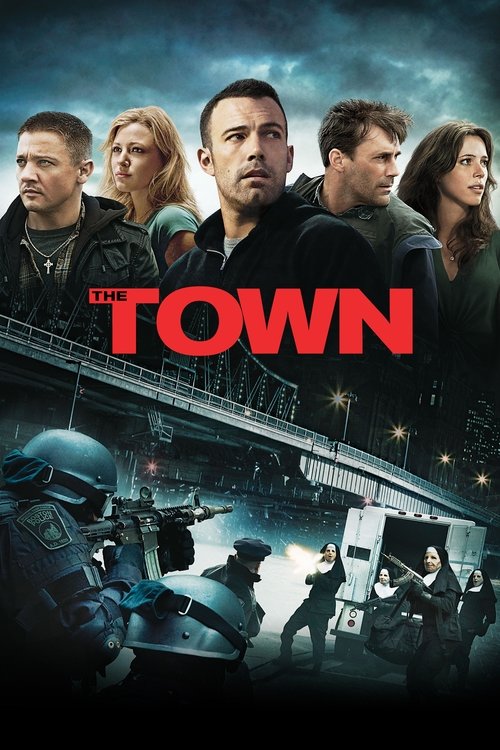
The Town
2010 · 125 min · Director: Ben Affleck
Show plot summary (may contain spoilers)
The Charlestown neighborhood of Boston is renowned for churning out a high number of armed robbers, generation after generation. These robbers never leave their Charlestown life on their own volition, the neighborhood where there is an unwritten code to protect that lifestyle. Such robbers include friends Doug MacRay, James Coughlin, Albert 'Gloansy' Magloan and Desmond Elden. Doug and James in particular treat each other like family, as the Coughlins have realistically been as such to Doug since Doug's mother ran off and Doug's father, Stephen MacRay, was sent to prison. James' single mother sister, the drugged out Krista Coughlin, and Doug have a casual sexual relationship. The foursome carry out a mostly successful bank robbery, but due to circumstances take the bank manager, Claire Keesey, hostage for a short period before releasing her physically unharmed. They find out that Claire lives in Charlestown, so they want to ensure that she did not see anything that could incriminate them if they were to ever run into her. As such, Doug begins a personal relationship with her to find out what she knows and what she's told the police and the FBI, who have taken charge of the investigation. He learns that she has kept some information from the authorities for her own protection but information that could identify James in particular. But Doug slowly falls for her, as she does for him. Ultimately, Doug dreams about leaving his Charlestown life to be with Claire anywhere but there. But Doug has to try and keep his true identity from her, and keep the fact that he is seeing her from his colleagues. But leaving is not as easy as he would like as he and the gang are tasked with a big job by a local gangster named Fergie whether Doug likes it or not. And Adam Frawley, the FBI's lead investigator, comes into evidence that links the foursome to the bank robbery and a subsequent armored car heist, so is on their tail for evidence that will send them away dead or alive.
Emotional fingerprint
The Town (2010) — Movie. Top emotional signals: Tension 35%, Anxiety 25%, Empathy 20%. Source: AI estimate. Shares describe emotional signal, not percentages of people. Your experience may differ. How we measure
- Tension35%
- Anxiety25%
- Empathy20%
- Excitement10%
- Satisfaction10%
AI estimate · no viewer votes yet
How we measure
AI estimate
Share of emotional signal, not the percentage of people or a probability of enjoyment.
Each viewer contributes one response, split equally across their selected emotions. When available, an automated estimate supplies a prior that is blended with those responses. Counts include distinct viewers, not automated estimates or archived anonymous votes. Fewer than 3 viewers is an early estimate; more responses do not guarantee certainty.
Why it feels this way
The strongest emotional signals are Tension, Anxiety, Empathy. Genres: Thriller, Drama, Crime. AI estimate.
Is it worth watching?
Consider this title if you are looking for Tension, Anxiety and Empathy. Its IMDb rating of 7.5/10 suggests a generally positive audience reception. For these leading emotions, its Feel Score is 74/100.
How did it make you feel?
Votes are saved to the fingerprint once you’re signed in.
Pick up to three · 0/3
Afterward Reveal viewer responses · may contain spoilers
Viewer responses about feelings after the title ended, separate from feelings while watching. No AI estimates.
0 responses so far
Feeling details appear after at least 3 viewers respond, to protect privacy.
Cast








Rusty
Agent Quinlan
Henry
Henry’s Girl
Vericom Crew Chief
Alex Colazzo
Beacon G.I. Joe Driver
BPD Sergeant at Krista's Accident
Inside Man at Fenway
Task Force Agent Conlan
Details
- Directed by
- Ben Affleck
- Written by
- Ben Affleck, Aaron Stockard, Peter Craig
- Type
- Movies
- Released
- 2010
- Runtime
- 125 min
- Country
- United States, United Kingdom
- Ratings
- Feels mostly
- Tension
- Data updated
Where to watch
Subscription


Rent


Feels similar
More like this →Emotion overlap shows mood similarity, not a prediction of enjoyment.