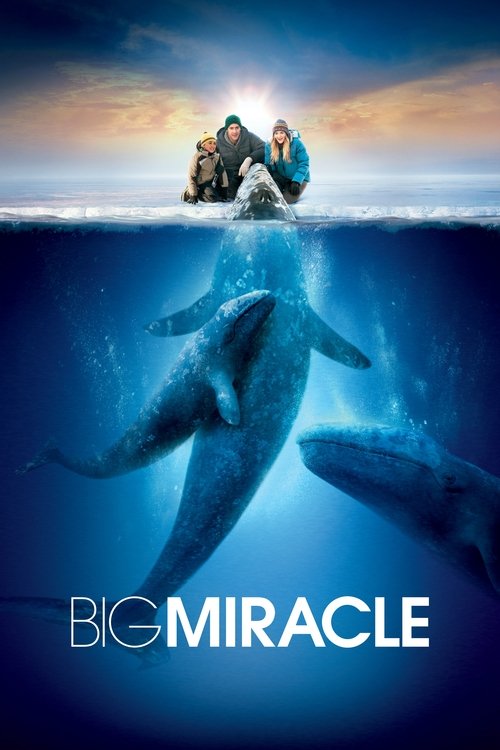
Big Miracle
2012 · 107 min · Director: Ken Kwapis
Show plot summary (may contain spoilers)
October, 1988. Adam Carlson, a reporter for a local Anchorage television station, is currently in Barrow doing a series of pieces on the "local cultural color" of northern Alaska. While out on the sea ice filming a less than promising piece, he spots off in the distance what ends up being three California gray whales - a mother, father and son - who are literally imprisoned by ice which has surrounded them in the earlier than usual onset of winter. They are looking worse for wear as they have been ramming the ice surface to maintain a hole in the ice to be able to breathe and thus survive. The professional and cultural assessment he receives is that the whales, in their current situation, cannot survive for more than a few days, with the ice fives miles in distance to the open ocean with a vertical ice shelf that has developed midway. Adam's piece on the whales not only gets played on his station, but is picked up by news services throughout the States, including the national broadcasters, which brings the plight of the whales to the attention of various different groups. First and foremost is Greenpeace, Anchorage-based Rachel Kramer in particular who will do anything to save the whales, she who happens to be Adam's ex-girlfriend the two having parted on not good terms. Rachel tries to manipulate those who can do something to do those somethings. Those groups include the governor's office, who she wants to request deployment of the National Guard specifically to transport via helicopter tow a privately owned hoverbarge capable of breaking through the ice. The problem for Rachel is that the hoverbarge is owned by her mortal enemy, J.W. McGraw of Alaskan Northern Oil, which wants drilling rights in the northern waters. More and more news services send their reporters to Barrow to cover the story, including Los Angeles based Jill Jerard after who Adam has long lusted from afar. The White House gets wind of the story, support for the whales which they are determined to demonstrate, as public support grows, that White House support especially important in an election year. And the local indigenous group, the Inupiat, initially plan to harvest the whales in their certain death in an effort to protect their natural hunting/fishing way of life, despite the gray whale specifically not being part of their natural diet.
Emotional fingerprint
Big Miracle (2012) — Movie. Top emotional signals: Empathy 35%, Anxiety 20%, Relief 20%. Source: AI estimate. Shares describe emotional signal, not percentages of people. Your experience may differ. How we measure
AI estimate · no viewer votes yet
How we measure
AI estimate
Share of emotional signal, not the percentage of people or a probability of enjoyment.
Each viewer contributes one response, split equally across their selected emotions. When available, an automated estimate supplies a prior that is blended with those responses. Counts include distinct viewers, not automated estimates or archived anonymous votes. Fewer than 3 viewers is an early estimate; more responses do not guarantee certainty.
Why it feels this way
The strongest emotional signals are Empathy, Anxiety, Relief. Genres: Drama, Romance, Biography. AI estimate.
Is it worth watching?
Consider this title if you are looking for Empathy, Anxiety and Relief. Its IMDb rating of 6.5/10 suggests a generally positive audience reception. For these leading emotions, its Feel Score is 67/100.
How did it make you feel?
Votes are saved to the fingerprint once you’re signed in.
Pick up to three · 0/3
Emotional journey
- Tension
- Hope
- Sadness
Not enough subtitle evidence
No dominant emotion
Dominant emotion: Empathy
Dominant emotion: Tension
Dominant emotion: Hope
Dominant emotion: Sadness
Dominant emotion: Relief
Dominant emotion
| % | Approximate minute | Dominant emotion | Overall intensity | Tension | Hope | Sadness |
|---|---|---|---|---|---|---|
| 2.5 % | ≈ 3′ | Empathy | 34 % | 21 % | 9 % | 12 % |
| 7.5 % | ≈ 8′ | Empathy | 40 % | 33 % | 12 % | 17 % |
| 12.5 % | ≈ 13′ | Tension | 44 % | 39 % | 23 % | 18 % |
| 17.5 % | ≈ 19′ | Hope | 42 % | 33 % | 35 % | 12 % |
| 22.5 % | ≈ 24′ | Hope | 45 % | 25 % | 44 % | 8 % |
| 27.5 % | ≈ 29′ | Hope | 49 % | 26 % | 44 % | 11 % |
| 32.5 % | ≈ 35′ | Empathy | 49 % | 38 % | 30 % | 14 % |
| 37.5 % | ≈ 40′ | Tension | 50 % | 44 % | 17 % | 18 % |
| 42.5 % | ≈ 45′ | Empathy | 52 % | 41 % | 16 % | 25 % |
| 47.5 % | ≈ 51′ | Empathy | 53 % | 43 % | 24 % | 27 % |
| 52.5 % | ≈ 56′ | Hope | 49 % | 44 % | 30 % | 21 % |
| 57.5 % | ≈ 62′ | Tension | 50 % | 46 % | 34 % | 16 % |
| 62.5 % | ≈ 67′ | Hope | 58 % | 54 % | 39 % | 16 % |
| 67.5 % | ≈ 72′ | Tension | 63 % | 60 % | 39 % | 20 % |
| 72.5 % | ≈ 78′ | Tension | 71 % | 63 % | 33 % | 38 % |
| 77.5 % | ≈ 83′ | Sadness | 78 % | 63 % | 32 % | 60 % |
| 82.5 % | ≈ 88′ | Hope | 79 % | 68 % | 46 % | 53 % |
| 87.5 % | ≈ 94′ | Relief | 77 % | 57 % | 54 % | 27 % |
| 92.5 % | ≈ 99′ | Relief | 72 % | 29 % | 53 % | 14 % |
| 97.5 % | ≈ 104′ | Not enough subtitle evidence | Not enough subtitle evidence | Not enough subtitle evidence | Not enough subtitle evidence | Not enough subtitle evidence |
Man in a hole
Rags to riches: The emotional tone rises from negative to positive.
Riches to rags: The emotional tone falls from positive to negative.
Man in a hole: The tone falls, then recovers.
Icarus: The tone rises, then falls.
Cinderella: The tone rises, falls, then rises again.
Oedipus: The tone falls, rises, then falls again.
AI reading of the film’s English subtitles (dialogue and sound cues) — not viewer votes. How we measure ↗
Afterward Reveal viewer responses · may contain spoilers
Viewer responses about feelings after the title ended, separate from feelings while watching. No AI estimates.
0 responses so far
Feeling details appear after at least 3 viewers respond, to protect privacy.
Cast












Frank
Don Carr
Stu


Barrow Street Reporter

Details
- Directed by
- Ken Kwapis
- Written by
- Jack Amiel, Michael Begler, Tom Rose, Michael Begler
- Type
- Movies
- Released
- 2012
- Runtime
- 107 min
- Country
- United States, United Kingdom
- Ratings
- Feels mostly
- Empathy
- Data updated
Where to watch
Subscription

Rent


Feels similar
More like this →Emotion overlap shows mood similarity, not a prediction of enjoyment.