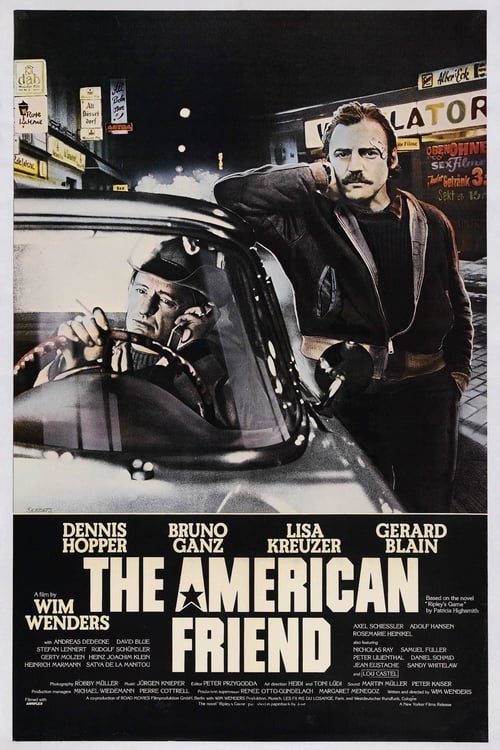
The American Friend
1977 · 125 min · Director: Wim Wenders
Show plot summary (may contain spoilers)
Tom Ripley, an American who deals in forged art, is slighted at an auction in Hamburg by picture framer Jonathan Zimmerman. When Ripley is asked by gangster Raoul Minot to kill a rival, he suggests Zimmerman, and the two, exploiting Zimmerman's terminal illness, coerce him into being a hitman.
Emotional fingerprint
The American Friend (1977) — Movie. Top emotional signals: Confusion 30%, Tension 25%, Anxiety 20%. Source: AI estimate. Shares describe emotional signal, not percentages of people. Your experience may differ. How we measure
AI estimate · no viewer votes yet
How we measure
AI estimate
Share of emotional signal, not the percentage of people or a probability of enjoyment.
Each viewer contributes one response, split equally across their selected emotions. When available, an automated estimate supplies a prior that is blended with those responses. Counts include distinct viewers, not automated estimates or archived anonymous votes. Fewer than 3 viewers is an early estimate; more responses do not guarantee certainty.
Why it feels this way
The strongest emotional signals are Confusion, Tension, Anxiety. Genres: Thriller, Drama, Crime. AI estimate.
Is it worth watching?
Consider this title if you are looking for Confusion, Tension and Anxiety. Its IMDb rating of 7.4/10 suggests a generally positive audience reception. For these leading emotions, its Feel Score is 72/100.
How did it make you feel?
Votes are saved to the fingerprint once you’re signed in.
Pick up to three · 0/3
Emotional journey
- Tension
- Sympathy
- Anxiety
Not enough subtitle evidence
No dominant emotion
Dominant emotion: Curiosity
Dominant emotion: Sympathy
Dominant emotion: Tension
Dominant emotion: Anxiety
Dominant emotion: Sadness
Dominant emotion
| % | Approximate minute | Dominant emotion | Overall intensity | Tension | Sympathy | Anxiety |
|---|---|---|---|---|---|---|
| 2.5 % | ≈ 3′ | Curiosity | 37 % | 17 % | 18 % | 17 % |
| 7.5 % | ≈ 9′ | Sympathy | 43 % | 28 % | 23 % | 23 % |
| 12.5 % | ≈ 16′ | Tension | 51 % | 43 % | 25 % | 35 % |
| 17.5 % | ≈ 22′ | Anxiety | 59 % | 48 % | 41 % | 48 % |
| 22.5 % | ≈ 28′ | Sympathy | 64 % | 46 % | 56 % | 54 % |
| 27.5 % | ≈ 34′ | Anxiety | 60 % | 40 % | 50 % | 53 % |
| 32.5 % | ≈ 41′ | Anxiety | 57 % | 42 % | 43 % | 50 % |
| 37.5 % | ≈ 47′ | Tension | 63 % | 55 % | 45 % | 52 % |
| 42.5 % | ≈ 53′ | Not enough subtitle evidence | Not enough subtitle evidence | Not enough subtitle evidence | Not enough subtitle evidence | Not enough subtitle evidence |
| 47.5 % | ≈ 59′ | Curiosity | 48 % | 40 % | 33 % | 33 % |
| 52.5 % | ≈ 66′ | Tension | 55 % | 50 % | 35 % | 40 % |
| 57.5 % | ≈ 72′ | Tension | 61 % | 60 % | 36 % | 48 % |
| 62.5 % | ≈ 78′ | Tension | 66 % | 66 % | 35 % | 53 % |
| 67.5 % | ≈ 84′ | Tension | 71 % | 69 % | 35 % | 51 % |
| 72.5 % | ≈ 91′ | Sympathy | 68 % | 58 % | 45 % | 41 % |
| 77.5 % | ≈ 97′ | Sadness | 66 % | 53 % | 50 % | 42 % |
| 82.5 % | ≈ 103′ | Tension | 74 % | 65 % | 49 % | 55 % |
| 87.5 % | ≈ 109′ | Tension | 77 % | 69 % | 56 % | 59 % |
| 92.5 % | ≈ 116′ | Sadness | 78 % | 63 % | 65 % | 58 % |
| 97.5 % | ≈ 122′ | Not enough subtitle evidence | Not enough subtitle evidence | Not enough subtitle evidence | Not enough subtitle evidence | Not enough subtitle evidence |
AI reading of the film’s English subtitles (dialogue and sound cues) — not viewer votes. How we measure ↗
Afterward Reveal viewer responses · may contain spoilers
Viewer responses about feelings after the title ended, separate from feelings while watching. No AI estimates.
0 responses so far
Feeling details appear after at least 3 viewers respond, to protect privacy.
Cast


Doctor in Paris
Daniel Zimmermann
Allan Winter
Old Lady
Dr. Gabriel
Angie
Lippo
Conductor
Mona
Details
- Directed by
- Wim Wenders
- Written by
- Wim Wenders, Patricia Highsmith
- Type
- Movies
- Released
- 1977
- Runtime
- 125 min
- Country
- France, Germany
- Ratings
- Feels mostly
- Confusion
- Data updated
Where to watch
Rent


Feels similar
More like this →Emotion overlap shows mood similarity, not a prediction of enjoyment.