
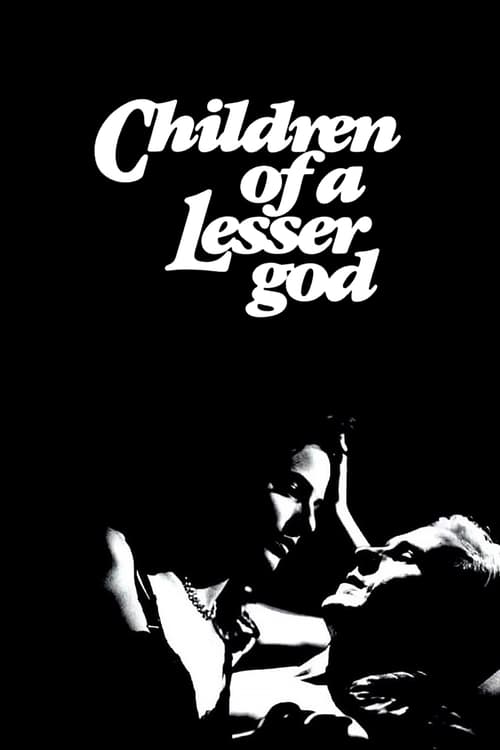
Children of a Lesser God
1986 · 119 min · Director: Randa Haines
Show plot summary (may contain spoilers)
Having taught at the best institutions in the country aside from other more eclectic jobs, James Leeds, with progressive methods, has just started teaching at a school for the deaf on an island off the New England coast, where he is assigned primarily to a speech class for the upper grades. At the school, he quickly notices the young cleaning woman, who he learns is twenty-five year old Sarah Norman and who, deaf herself, was once a student there and has been there since the age of five. He can see that she is bright, headstrong and angry, on top of which she doesn't speak, the latter issues a result of a troubled home life, her mother, her only touchstone to family, who she has purposefully not seen in eight years. As he is able to get through to most of his students to feel more and more comfortable in speaking for a more holistic life, Jim, with the reluctant blessing of the school's superintendent Dr. Curtis Franklin, who has always and still considers Sarah a proverbial pain in the you-know-where, tries to get Sarah to learn how to speak so that she can reach her full potential beyond being a cleaning woman, which he will further learn is a choice if only as it allows her to live her life somewhat in solitude in her silence and anger. Although unable to break through to her on the speaking side of the equation, he is able to break through on a more humanistic level as they end up falling for each other eventually embark on a relationship. The question then becomes if there is the possibility of a long term future for them, especially in being able to bridge their many divides - not only the divide between the world of the hearing and the deaf - and in Sarah never having had a sense of who she truly is as a complete human being and not just the deaf girl who may now see what Jim is doing as solely his latest "project".
Emotional fingerprint
Children of a Lesser God (1986) — Movie. Top emotional signals: Empathy 30%, Love 25%, Sadness 20%. Source: AI estimate. Shares describe emotional signal, not percentages of people. Your experience may differ. How we measure
AI estimate · no viewer votes yet
How we measure
AI estimate
Share of emotional signal, not the percentage of people or a probability of enjoyment.
Each viewer contributes one response, split equally across their selected emotions. When available, an automated estimate supplies a prior that is blended with those responses. Counts include distinct viewers, not automated estimates or archived anonymous votes. Fewer than 3 viewers is an early estimate; more responses do not guarantee certainty.
Why it feels this way
The strongest emotional signals are Empathy, Love, Sadness. Genres: Drama, Romance. AI estimate.
Is it worth watching?
Consider this title if you are looking for Empathy, Love and Sadness. Its IMDb rating of 7.2/10 suggests a generally positive audience reception. For these leading emotions, its Feel Score is 72/100.
How did it make you feel?
Votes are saved to the fingerprint once you’re signed in.
Pick up to three · 0/3
Emotional journey
- Empathy
- Sadness
- Love
Not enough subtitle evidence
No dominant emotion
Dominant emotion: Humor
Dominant emotion: Empathy
Dominant emotion: Love
Dominant emotion: Tension
Dominant emotion: Sadness
Dominant emotion
| % | Approximate minute | Dominant emotion | Overall intensity | Empathy | Sadness | Love |
|---|---|---|---|---|---|---|
| 2.5 % | ≈ 3′ | Humor | 36 % | 17 % | 3 % | 0 % |
| 7.5 % | ≈ 9′ | Humor | 41 % | 20 % | 3 % | 2 % |
| 12.5 % | ≈ 15′ | Humor | 43 % | 26 % | 8 % | 5 % |
| 17.5 % | ≈ 21′ | Empathy | 42 % | 31 % | 14 % | 9 % |
| 22.5 % | ≈ 27′ | Humor | 43 % | 29 % | 9 % | 20 % |
| 27.5 % | ≈ 33′ | Love | 46 % | 30 % | 10 % | 30 % |
| 32.5 % | ≈ 39′ | Empathy | 56 % | 45 % | 30 % | 31 % |
| 37.5 % | ≈ 45′ | Empathy | 64 % | 55 % | 44 % | 35 % |
| 42.5 % | ≈ 51′ | Love | 57 % | 43 % | 28 % | 44 % |
| 47.5 % | ≈ 57′ | Love | 54 % | 35 % | 12 % | 49 % |
| 52.5 % | ≈ 62′ | Love | 55 % | 34 % | 9 % | 45 % |
| 57.5 % | ≈ 68′ | Humor | 54 % | 34 % | 14 % | 35 % |
| 62.5 % | ≈ 74′ | Tension | 55 % | 43 % | 29 % | 32 % |
| 67.5 % | ≈ 80′ | Empathy | 56 % | 51 % | 39 % | 31 % |
| 72.5 % | ≈ 86′ | Empathy | 64 % | 56 % | 44 % | 26 % |
| 77.5 % | ≈ 92′ | Tension | 77 % | 66 % | 56 % | 25 % |
| 82.5 % | ≈ 98′ | Sadness | 77 % | 71 % | 64 % | 33 % |
| 87.5 % | ≈ 104′ | Empathy | 64 % | 58 % | 48 % | 41 % |
| 92.5 % | ≈ 110′ | Love | 55 % | 43 % | 27 % | 45 % |
| 97.5 % | ≈ 116′ | Not enough subtitle evidence | Not enough subtitle evidence | Not enough subtitle evidence | Not enough subtitle evidence | Not enough subtitle evidence |
Riches to rags
Rags to riches: The emotional tone rises from negative to positive.
Riches to rags: The emotional tone falls from positive to negative.
Man in a hole: The tone falls, then recovers.
Icarus: The tone rises, then falls.
Cinderella: The tone rises, falls, then rises again.
Oedipus: The tone falls, rises, then falls again.
AI reading of the film’s English subtitles (dialogue and sound cues) — not viewer votes. How we measure ↗
Afterward Reveal viewer responses · may contain spoilers
Viewer responses about feelings after the title ended, separate from feelings while watching. No AI estimates.
0 responses so far
Feeling details appear after at least 3 viewers respond, to protect privacy.
Cast



Lydia
Johnny
Glen
Cheryl
Danny
Tony
William
Orin
Alan Jones
Tom Schuyler
Marian Loesser
Martha Franklin
Glen's Father
Glen's Mother
Details
- Directed by
- Randa Haines
- Written by
- Mark Medoff, Hesper Anderson, James Carrington
- Type
- Movies
- Released
- 1986
- Runtime
- 119 min
- Country
- United States
- Ratings
- Feels mostly
- Empathy
- Data updated
Where to watch
Subscription


Rent


Feels similar
More like this →Emotion overlap shows mood similarity, not a prediction of enjoyment.