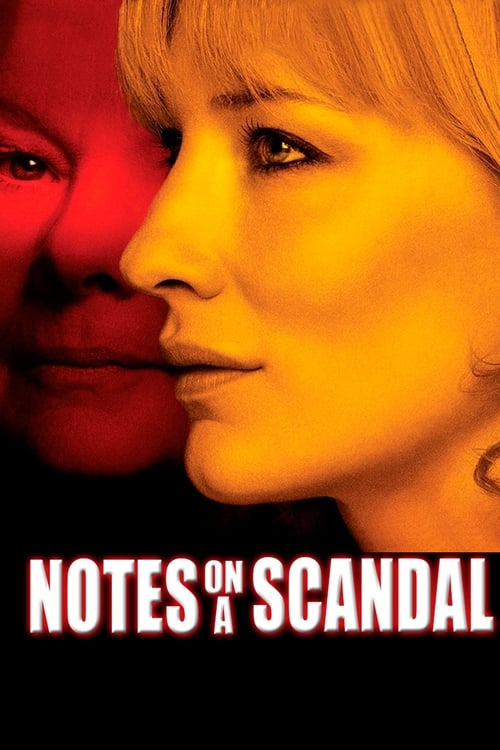
Notes on a Scandal
2006 · 92 min · Director: Richard Eyre
Show plot summary (may contain spoilers)
Bitter, cynical, and lonely Barbara Covett (Dame Judi Dench) is a tough and conservative teacher, near to retirement, who is loathed by her colleagues and students. In the loneliness of her apartment, she spends her spare time writing in her journal, taking care of her old cat Portia, and missing her special friend Jennifer Dodd. When Sheba Hart (Cate Blanchett) joins the high school as the new art teacher, Barbara dedicates her attention to the newcomer, writing sharp and unpleasant comments about her behavior and clothes. When Barbara helps Sheba in a difficult situation with two students, the grateful Sheba invites her to have lunch with her family. Sheba introduces her husband and former professor Richard Hart (Bill Nighy), who is about twenty years older than her; her rebellious teenager daughter Polly (Juno Temple); and her son Ben (Max Lewis), who has Down's Syndrome. Barbara becomes close to Sheba, but when she accidentally discovers that Sheba is having an affair with fifteen-year-old student Steven Connolly (Andrew Simpson), Barbara sees the chance to manipulate and get closer to Sheba, hiding the secret from the school headmaster. When Portia dies and Sheba does not stay with Barbara in the veterinary office to see Ben in a theater play, Barbara plots a Machiavellian revenge against Sheba, creating a scandal and consequent turmoil in their lives.
Emotional fingerprint
Notes on a Scandal (2006) — Movie. Top emotional signals: Anxiety 30%, Disturbing 25%, Empathy 20%. Source: AI estimate. Shares describe emotional signal, not percentages of people. Your experience may differ. How we measure
- Anxiety30%
- Disturbing25%
- Empathy20%
- Tension15%
- Guilt10%
AI estimate · no viewer votes yet
How we measure
AI estimate
Share of emotional signal, not the percentage of people or a probability of enjoyment.
Each viewer contributes one response, split equally across their selected emotions. When available, an automated estimate supplies a prior that is blended with those responses. Counts include distinct viewers, not automated estimates or archived anonymous votes. Fewer than 3 viewers is an early estimate; more responses do not guarantee certainty.
Why it feels this way
The strongest emotional signals are Anxiety, Disturbing, Empathy. Genres: Drama, Romance, Crime. AI estimate.
Is it worth watching?
Consider this title if you are looking for Anxiety, Disturbing and Empathy. Its IMDb rating of 7.4/10 suggests a generally positive audience reception. For these leading emotions, its Feel Score is 73/100.
How did it make you feel?
Votes are saved to the fingerprint once you’re signed in.
Pick up to three · 0/3
Emotional journey
- Tension
- Disturbing
- Sadness
Not enough subtitle evidence
No dominant emotion
Dominant emotion: Curiosity
Dominant emotion: Humor
Dominant emotion: Sadness
Dominant emotion: Disturbing
Dominant emotion: Tension
Dominant emotion
| % | Approximate minute | Dominant emotion | Overall intensity | Tension | Disturbing | Sadness |
|---|---|---|---|---|---|---|
| 2.5 % | ≈ 2′ | Curiosity | 41 % | 23 % | 16 % | 7 % |
| 7.5 % | ≈ 7′ | Humor | 40 % | 24 % | 16 % | 9 % |
| 12.5 % | ≈ 12′ | Humor | 38 % | 17 % | 13 % | 15 % |
| 17.5 % | ≈ 16′ | Curiosity | 38 % | 12 % | 10 % | 23 % |
| 22.5 % | ≈ 21′ | Sadness | 46 % | 22 % | 20 % | 26 % |
| 27.5 % | ≈ 25′ | Curiosity | 61 % | 45 % | 44 % | 18 % |
| 32.5 % | ≈ 30′ | Disturbing | 70 % | 60 % | 63 % | 13 % |
| 37.5 % | ≈ 35′ | Disturbing | 67 % | 56 % | 57 % | 21 % |
| 42.5 % | ≈ 39′ | Sadness | 53 % | 39 % | 33 % | 34 % |
| 47.5 % | ≈ 44′ | Sadness | 54 % | 40 % | 35 % | 41 % |
| 52.5 % | ≈ 48′ | Disturbing | 70 % | 59 % | 61 % | 39 % |
| 57.5 % | ≈ 53′ | Disturbing | 74 % | 64 % | 68 % | 42 % |
| 62.5 % | ≈ 58′ | Sadness | 70 % | 60 % | 58 % | 44 % |
| 67.5 % | ≈ 62′ | Curiosity | 71 % | 65 % | 55 % | 36 % |
| 72.5 % | ≈ 67′ | Tension | 78 % | 75 % | 61 % | 42 % |
| 77.5 % | ≈ 71′ | Tension | 80 % | 74 % | 65 % | 53 % |
| 82.5 % | ≈ 76′ | Disturbing | 79 % | 72 % | 70 % | 56 % |
| 87.5 % | ≈ 81′ | Tension | 80 % | 69 % | 69 % | 59 % |
| 92.5 % | ≈ 85′ | Sadness | 66 % | 50 % | 51 % | 51 % |
| 97.5 % | ≈ 90′ | Curiosity | 52 % | 37 % | 40 % | 35 % |
Riches to rags
Rags to riches: The emotional tone rises from negative to positive.
Riches to rags: The emotional tone falls from positive to negative.
Man in a hole: The tone falls, then recovers.
Icarus: The tone rises, then falls.
Cinderella: The tone rises, falls, then rises again.
Oedipus: The tone falls, rises, then falls again.
AI reading of the film’s English subtitles (dialogue and sound cues) — not viewer votes. How we measure ↗
Kadri — your film companion
AIAsk anything about Notes on a Scandal. From the film’s own dialogue and FeelDB data, at your spoiler level.
Afterward Reveal viewer responses · may contain spoilers
Viewer responses about feelings after the title ended, separate from feelings while watching. No AI estimates.
0 responses so far
Feeling details appear after at least 3 viewers respond, to protect privacy.
Cast





Ben Hart

Ted Mawson
Linda
Gita
Antonia Robinson
Davis
Lorraine
Dave

Details
- Directed by
- Richard Eyre
- Written by
- Patrick Marber, Zoë Heller
- Type
- Movies
- Released
- 2006
- Runtime
- 92 min
- Country
- United Kingdom, United States
- Ratings
- Feels mostly
- Anxiety
- Data updated
Where to watch
Rent


Also on
Availability varies by country
Feels similar
More like this →Emotion overlap shows mood similarity, not a prediction of enjoyment.