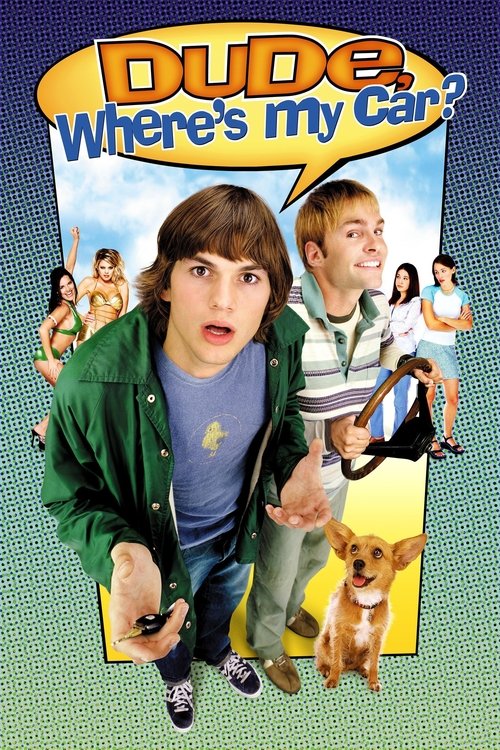
Dude, Where's My Car?
2000 · 83 min · Director: Danny Leiner
Show plot summary (may contain spoilers)
Roommates Jesse and Chester, both who have more than just a few cards short of a full deck, are stoner dudes who don't even do their jobs as pizza delivery guys well. They awaken one morning having little recollection of what they did the previous night, due to being wasted. They discover that their kitchen is full of prepackaged pudding, how they got all the pudding they are unaware. From a telephone message they receive, they come to the realization that at some point during the previous night they were at a party at the house of their girlfriends, twins Wanda and Wilma, and that today is their one year anniversary, which they did remember as they already bought the twins gifts. But the worst thing in not remembering what happened last night is that Jesse's car is missing. In trying to find out what happened to the car, they believe they have to recreate the feeling and mindset of last night, meaning getting wasted all over again. In trying to find the car, they, being the types that area easily distracted, get sidetracked by one item after another, most specifically the potential of having sex with hot babes (sex with which Wanda and Wilma have not yet provided them), and learning that they apparently had a suitcase filled with $200,000 last night, the suitcase and therefore the money to which they don't know what happened. During their day of discovery, they also end up encountering one group of alien wannabes, and two groups of actual aliens, all three groups who are after the continuum transfunctioner which they believe Jesse and Chester have. Jesse and Chester don't know where it is let alone what it is, but these three groups seem to be willing to do whatever necessary to get it from Jesse and Chester. In the process, Jesse and Chester may have to make decisions which may not only save their lives and those of Wanda, Wilma and their best friend Nelson, a zen-master, but that of the entire universe. But most importantly, they may actually find Jesse's car after all is said and done.
Emotional fingerprint
Dude, Where's My Car? (2000) — Movie. Top emotional signals: Humor 45%, Confusion 25%, Surprise 15%. Source: AI estimate. Shares describe emotional signal, not percentages of people. Your experience may differ. How we measure
- Humor45%
- Confusion25%
- Surprise15%
- Excitement10%
- Relief5%
AI estimate · no viewer votes yet
How we measure
AI estimate
Share of emotional signal, not the percentage of people or a probability of enjoyment.
Each viewer contributes one response, split equally across their selected emotions. When available, an automated estimate supplies a prior that is blended with those responses. Counts include distinct viewers, not automated estimates or archived anonymous votes. Fewer than 3 viewers is an early estimate; more responses do not guarantee certainty.
Why it feels this way
The strongest emotional signals are Humor, Confusion, Surprise. Genres: Comedy, Mystery, Sci-Fi. AI estimate.
Is it worth watching?
Consider this title if you are looking for Humor, Confusion and Surprise. Its IMDb rating of 5.6/10 suggests a mixed audience reception; consider how well the emotional profile suits you. For these leading emotions, its Feel Score is 59/100.
How did it make you feel?
Votes are saved to the fingerprint once you’re signed in.
Pick up to three · 0/3
Emotional journey
- Humor
- Relief
- Excitement
Not enough subtitle evidence
No dominant emotion
Dominant emotion: Humor
Dominant emotion: Relief
Dominant emotion
| % | Approximate minute | Dominant emotion | Overall intensity | Humor | Relief | Excitement |
|---|---|---|---|---|---|---|
| 2.5 % | ≈ 2′ | Humor | 40 % | 38 % | 3 % | 13 % |
| 7.5 % | ≈ 6′ | Humor | 51 % | 50 % | 5 % | 14 % |
| 12.5 % | ≈ 10′ | Humor | 60 % | 60 % | 4 % | 15 % |
| 17.5 % | ≈ 15′ | Humor | 61 % | 61 % | 3 % | 20 % |
| 22.5 % | ≈ 19′ | Humor | 58 % | 57 % | 4 % | 21 % |
| 27.5 % | ≈ 23′ | Humor | 59 % | 58 % | 4 % | 20 % |
| 32.5 % | ≈ 27′ | Humor | 61 % | 60 % | 4 % | 25 % |
| 37.5 % | ≈ 31′ | Humor | 58 % | 56 % | 10 % | 24 % |
| 42.5 % | ≈ 35′ | Humor | 57 % | 56 % | 16 % | 20 % |
| 47.5 % | ≈ 39′ | Humor | 57 % | 57 % | 9 % | 19 % |
| 52.5 % | ≈ 44′ | Humor | 57 % | 57 % | 7 % | 19 % |
| 57.5 % | ≈ 48′ | Humor | 58 % | 57 % | 12 % | 22 % |
| 62.5 % | ≈ 52′ | Humor | 58 % | 56 % | 12 % | 26 % |
| 67.5 % | ≈ 56′ | Humor | 58 % | 55 % | 17 % | 24 % |
| 72.5 % | ≈ 60′ | Humor | 60 % | 57 % | 20 % | 24 % |
| 77.5 % | ≈ 64′ | Humor | 63 % | 57 % | 23 % | 37 % |
| 82.5 % | ≈ 68′ | Humor | 69 % | 57 % | 37 % | 51 % |
| 87.5 % | ≈ 73′ | Relief | 71 % | 60 % | 48 % | 49 % |
| 92.5 % | ≈ 77′ | Humor | 62 % | 57 % | 34 % | 31 % |
| 97.5 % | ≈ 81′ | Humor | 49 % | 47 % | 15 % | 17 % |
Cinderella
Rags to riches: The emotional tone rises from negative to positive.
Riches to rags: The emotional tone falls from positive to negative.
Man in a hole: The tone falls, then recovers.
Icarus: The tone rises, then falls.
Cinderella: The tone rises, falls, then rises again.
Oedipus: The tone falls, rises, then falls again.
AI reading of the film’s English subtitles (dialogue and sound cues) — not viewer votes. How we measure ↗
Kadri — your film companion
AIAsk anything about Dude, Where's My Car?. From the film’s own dialogue and FeelDB data, at your spoiler level.
Afterward Reveal viewer responses · may contain spoilers
Viewer responses about feelings after the title ended, separate from feelings while watching. No AI estimates.
0 responses so far
Feeling details appear after at least 3 viewers respond, to protect privacy.
Cast





Nordic Dude #1
Nordic Dude #2
Jeff

Zellner
Zilbor
Big Cult Guard #1
Big Cult Guard #2
Gene
Tania
Details
- Directed by
- Danny Leiner
- Written by
- Philip Stark
- Type
- Movies
- Released
- 2000
- Runtime
- 83 min
- Country
- United States
- Ratings
- Feels mostly
- Humor
- Data updated
Where to watch
Rent


Feels similar
More like this →Emotion overlap shows mood similarity, not a prediction of enjoyment.